




April 6, 2026 Peer mentors help new Cougs build confidence and community
By Flynn Espe
Washington State University Tri-Cities student Roxie Bates remembers coming to New Coug Orientation last fall feeling somewhat anxious about starting her college career.
“What if I don’t do this one thing and then it ruins everything?” she recalls thinking. “I was very nervous.”
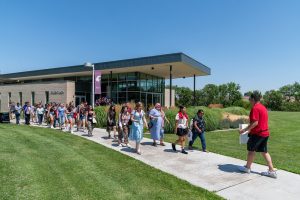
Peer mentors serve as orientation leaders before working with their new students.
Though she’d been on campus at least once before, it was a much different environment than the one she’d recently graduated from at Chiawana High School in Pasco. More than that, as a first-year student in the WSU Tri-Cities Teaching Bridge Program, Bates still had practical questions about how she would be balancing her time between taking classes and working part-time as a paraeducator — one of the main features of her elementary education program.
Fortunately, Bates says, most of her day-one jitters were quickly calmed when she went into a scheduled group meeting with Lisandra Farías, her assigned mentor in a brand-new Student Success Peer Mentors program aimed at helping new WSU Tri-Cities students settle in during their first semester on campus. Farías introduced herself to the group as a senior elementary education major.
“She kind of explained everything, like, ‘I’ve been through it. This is what it’s going to look like, and if you have any questions, I’m here,” Bates says. “It was a lot more reassuring.”
From there, Bates stayed in frequent contact with Farías throughout the semester, using a special text messaging platform.
“I would say we talked about one to two times a week. And it would often just be a quick check-in, like, ‘Hey, how’s everything going? Do you have any questions?’” Bates says.
Bates and her fellow new Cougs weren’t the only ones going through the peer mentorship process for the first time. This being the pilot year for the program, it was a learning experience for everyone — students and staff included.
“The point is to help new students, both first-years and transfers, successfully transition to life at WSU Tri-Cities by offering guidance, support, and a friendly connection to the campus community,” says Evelyn Martinez-Ostrom, WSU Tri-Cities’ director of student engagement and leadership.
She says the program emerged from a series of director-level meetings the year prior in which campus leaders from the Office of Academic and Student Affairs looked closely at an industry study on student success in higher education. In evaluating the results of a 2014 Gallup poll, which identified the “Big Six” college experiences linked to lifelong preparedness, the group latched on to two key indicators. One was a correlation between successful outcomes for students who were highly active in extracurricular activities and organizations. A second indicator was having a mentor to inspire and encourage the student.
“It was really broadly stated as somebody that has their back on campus, and an overwhelming number of examples cited a peer as that mentor,” Martinez-Ostrom says. “So the combination of those two things, having a peer mentor and having involvement in co-curricular activities, is what we centered this idea of a peer mentor program around.”
Getting the program up and running required a major effort from multiple WSU Tri-Cities departments, including the Office of Admissions and Office of Academic Engagement. Funding for the first year of the program was provided by a generous outside sponsorship from Battelle, with additional contributions from the WSU Tri-Cities College of Arts and Sciences and TRIO Student Support Services.
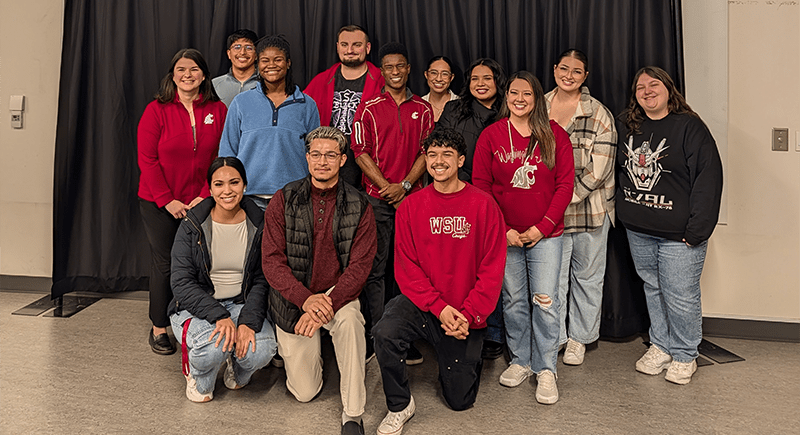
By the time fall 2025 orientation arrived, Martinez-Ostrom’s office had assembled and trained a team of 14 WSU Tri-Cities upperclassmen as peer mentors — selecting candidates through a competitive hiring process that also sought to bring in a mixed representation of undergraduate majors.
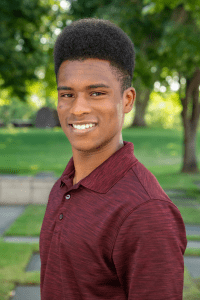
Devin Simpson, WSU Tri-Cities digital technology and culture major.
Peer mentor Devin Simpson, who graduated last December as a digital technology and culture major, says he decided to apply to the campus position having previously worked as a student outreach ambassador for the WSU Tri-Cities GEAR UP program.
“I was interested in it because I had experience interacting with students,” he says. “I thought, ‘Oh, that could translate well into the Student Success Peer Mentors position.’”
For his orientation meet-and-greet session, Simpson prepared a few simple games and ice-breaker activities to help people get to know one another.
“I had them talk about themselves and why they enrolled at WSU,” Simpson says. “They were meeting for the first time, so obviously nerves were going to be a little bit high. But the more I talked to them and the more activities and games we did, the more comfortable they got.”
Throughout the fall, Simpson and his fellow mentors regularly reached out to their assigned students via group and personalized texts, informing students about academic deadlines and resources while encouraging them to participate in upcoming social events. The new students, meanwhile, were also free to contact their mentors with questions and requests.
One peer mentor guided a new student through the process of starting a campus club for the education students, Martinez-Ostrom says. Sometimes the requests were more urgent.
“At one point we had a peer mentor who was off-campus, and one of their mentees had messaged them, ‘Hey, I have an exam today. I forgot my calculator. Can you help me with this?’” Martinez-Ostrom says. “The peer mentor contacted me, ‘I need to help my mentee. Are you on campus? Can you find a calculator for her?’ I said, ‘Yes, send her to our office.’ And we had a TI-89 waiting for her.”
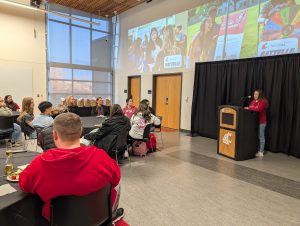
Viticulture and enology student Alyssa Perez shares her experience being a peer mentor at the “Cheers for Peers” event.
To celebrate the completion of the first semester of the program, the Office of Student Engagement and Leadership hosted a special “Cheers for Peers” event in the Student Union Building last December. While there, each of the 14 mentors had a chance to stand up and share about their experience.
Peer mentor Alyssa Perez, a senior viticulture and enology major, said being in the program taught her valuable lessons about leadership.
“Real leadership often looks like stepping back. You have to listen first, ask questions, and create a space for someone else’s voice to be heard,” Perez told the group. “I also learned that small moments matter more than we think. A quick check-in, a high five in the hallway, or a ‘You’ve got this!’ at just the right time — those interactions can be the thing that keeps someone going.”
For questions about applying to the peer mentor program for fall 2026, email Martinez-Ostrom at evelynmtz@wsu.edu.