



April 23, 2026 Twelve WSU students named IEEE Power & Energy Society scholars
By Flynn Espe
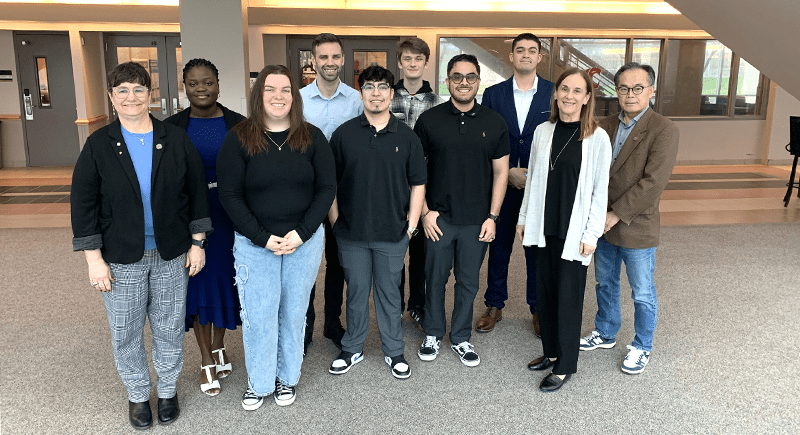
Twelve students from the Washington State University system have received the 2025-26 Power & Energy Society (PES) Scholarship Plus, making WSU the top institutional producer of PES scholars for this award year.
The PES Scholarship Plus is presented on behalf of the Institute of Electrical and Electronics Engineers (IEEE) and can award students up to $10,000 over a three-year period. The scholarship is given to high-achieving undergraduate students majoring in an IEEE-designated field of study who are pursuing careers in power and energy.
The 12 WSU students, who hail from three system campuses, comprised almost a third of the 38 total PES scholars chosen from colleges and universities in IEEE’s Western U.S.A. region, a cluster that includes 12 states. The students are:
- Katelyn Albertin, WSU Tri-Cities
- Gianni Avilan Losee, WSU Vancouver
- Gerrit Bruland, WSU Pullman
- Hugo Contreras, WSU Tri-Cities
- Jacob Culligan, WSU Tri-Cities
- Daniel Gapper, WSU Pullman
- David Hysjulien, WSU Tri-Cities
- Jesus Miranda, WSU Tri-Cities
- Miguel Palomino, WSU Tri-Cities
- Jessica Pantoja-Garcia, WSU Vancouver
- Tarang Teredesai, WSU Pullman
- Manuella Tossa, WSU Tri-Cities
Bruland and Tossa are both two-time recipients.
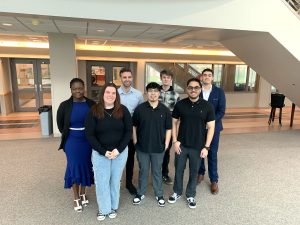
WSU Tri-Cities recipients from left to right in front:
Katelyn Albertin, electrical engineering; Miguel Palomino, electrical engineering; Jesus Miranda, computer science
WSU Tri-Cities recipients from left to right in back:
Manuella Tossa, electrical engineering; David Hysjulien, electrical engineering; Jacob Culligan, electrical engineering; Hugo Contreras, electrical engineering
To qualify for the scholarship, students must be considering a career in electric power and energy engineering, having earned a minimum number of academic credits within those areas of study. Applicants are evaluated by way of grades, achievements, work experiences, and volunteer activities. Selection is also based on the quality of the institution’s academic programs and curriculum related to power and energy engineering.
Palomino, a first-time recipient majoring in electrical engineering with minors in computer science and mathematics, found out about the PES scholarship through his academic advisor. He says he’s currently interested in working on energy systems that are healthier for the environment, noting that emerging technologies like ChatGPT and other large language models have proven to be heavily energy dependent.
As a student intern at Pacific Northwest National Laboratory (PNNL) since 2023, Palomino has contributed to research projects involving high-voltage systems analysis for an experimental time projection chamber, the creation of an automatic cooling system, and more.
“My second project at PNNL, I created a standalone digital display system for a pressure transducer,” Palomino said. “For this, I had to integrate a microcontroller, analog-to-digital converter, and a digital display screen. This system required me to create a voltage divider to scale down the input signal to prevent any damage to the components.”
After earning his associate’s degree from Columbia Basin College, Palomino transferred to WSU Tri-Cities as a part of the Bridges Program and expects to graduate with his bachelor’s in electrical engineering in the spring of 2027.
“I feel honored to be recognized by IEEE,” he said. “It is encouraging to know that others have faith in me and are willing to give me that support which I greatly need.”
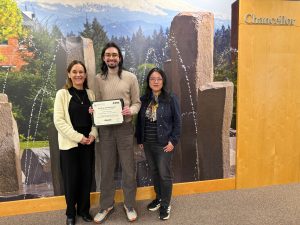
Sandra Haynes, executive vice president for WSU statewide campuses; Gianni Avilan Losee, electrical engineering; Xinghui Zhao, director for the WSU Vancouver School of Engineering and Computer Science. (Not pictured: Jessica Pantoja-Garcia, electrical engineering)
Pantoja-Garcia, who transferred from Clark College to WSU Vancouver in 2023, said she became interested in the field thanks to power-related projects and classes, as well as her participation in the PNW Hydro Think Tank Competition. At WSU Vancouver, it was her Intro to Power and Energy Systems course and two key electives — Renewable Energy Conversion Systems and Introduction to Solar Cells — that further cemented her enthusiasm.
“Both of these electives stood out to me from other electrical engineering classes I have taken because they involved learning with a project-based approach,” Pantoja-Garcia said. “As a student, I have found that when I am tasked with projects instead of problem sets, I feel more involved and a sense of ownership over my education.”
Outside of the classroom, Pantoja-Garcia took part in two four-month electrical engineering internships with Burns & McDonnell — an architecture, engineering, and construction firm. She recently joined the company as a full-time assistant substation engineer after graduating in December with a bachelor’s in electrical engineering.
“I spent most of my time working on substation projects,” Pantoja-Garcia said. “In my application, I described how my internship allowed me to take on projects that directly affected our electric grid and that it taught me the importance of making safe and smart design choices.”
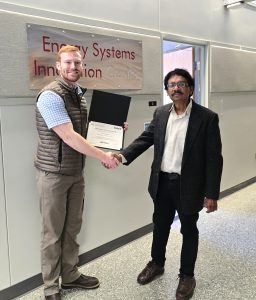
Gerrit Bruland, electrical engineering, and Mani V. Venkatasubramanian, director of the WSU Energy Systems Innovation Center at WSU Pullman.
The PES Scholarship Plus program grew sharply over the past year, increasing from 84 PES scholars in 2024 to 244 in 2025. The jump was driven in part by expanded eligibility, which now includes majors such as computer science, technical communications, education, and more. WSU students outpaced that growth, rising from two scholars last year to 12 this year.
According to Noel Schulz, inaugural director of the WSU Tri-Cities Institute for Northwest Energy Futures and Bob Ferguson endowed professor, who joined the IEEE board of directors in 2024, it’s a promising sign for the trajectory of WSU’s programs.
“This is a significant accomplishment for the entire WSU system,” Schulz said. “It’s encouraging to see that our students are excelling not only in the labs and classrooms on campus but also being recognized by professional societies like IEEE PES. The WSU system continues to be a strong program in electrical power education and research. It’s a true testament to our incredible engineering faculty and curriculum that WSU is producing so many talented and committed students.”