




November 10, 2025 Retired Navy chief charts new course as dual-major WSU Tri-Cities student
By Flynn Espe
When Washington State University Tri-Cities student Jeff Wilson looks back on his 21-year career in the U.S. Navy, there’s no shortage of memorable places and experiences that spring to mind.
“I was turning wrenches on airplanes and going out to sea, watching the sunset—then working all night, looking at the stars and watching the sunrise again,” he says. “It was wonderful.”
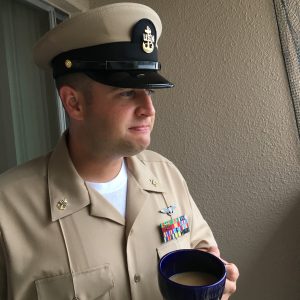
Jeff Wilson retired from the U.S. Navy as chief petty officer in 2022.
Wilson enlisted in May 2001. His military service took him to both coasts of the continental United States—including in Virginia, California and Florida—and twice to Japan. His first job was servicing fixed-wing aircraft, working on hydraulics and metalcraft for the E-2C Hawkeye and C-2A Greyhound, before moving on to helicopters. After serving for a few years as a recruiter in his home state of Washington, he returned to the world of aircraft, directing flight deck operations and supervising others in daily maintenance. At one point during his first station in Japan, having achieved the rank of chief petty officer, Wilson oversaw 34 enlisted sailors.
“I made the rules, took their input and tried to have fun and make it as family-ish as we could,” Wilson says. “There were a bunch of administrative skills that that I picked up along the way as far as organization goes, meeting deadlines and that kind of thing—being able to work with anybody from anywhere, with any kind of background.”
By the time he retired in 2022, Wilson says he wasn’t sure what he wanted to do next, only that he was eager to try out something new. Taking advantage of his GI Bill education benefits, he eventually chose WSU Tri-Cities to pursue his bachelor’s degree and the surrounding community as a new place to settle with his wife and two young boys, hoping to be close to his extended family as well.
“We drove over here from Pensacola and then lived in my sister’s friend’s basement for a few weeks while we looked for a place to live,” Wilson says.
Today, Wilson is on track to graduate this spring with not one, but two undergraduate degrees from WSU Tri-Cities. His first major, a B.A. in Social Sciences, was completed in 2024.
“I had a focus on anthropology, history and psychology, and that was fun because I got to write in a lot of different styles,” he says of his first two years as a Social Sciences major. “I just had a really good time researching and writing papers.”
With some education benefits remaining after his first graduation, Wilson wasn’t ready to move on from WSU just yet. Not wanting to enter a master’s program, however, he instead opted for a second major in Digital Technology and Culture (DTC).
“One of the UCORE classes I took was a DTC class with Assistant Professor Phillip Mudd, and it was using Photoshop and Illustrator,” Wilson says. “I had a whole lot of fun doing that.”
Designed for students who want to explore a wide range of creative media and storytelling formats, the Digital Technology and Culture major gives students extensive hands-on experience in areas such as web and graphic design, 3D animation and more.
“We’re really getting familiar with the Adobe Suite,” he says. “I’ve learned a lot of about myself and just how hard it is to create something.”
For one recent assignment, Wilson and his classmates each designed and built their own version of a Rube Goldberg machine, in which the machine’s purpose revolves around a playfully overcomplicated—as opposed to practical—outcome. Determined not to spend money on his device, Wilson used random tools from his home garage, including at least one component that harkens back to his naval roots.
“I have an 18-inch marlinspike, which is a tool that the boatswain’s mates used to tie knots and big lines for ships,” he says. “I have a sign that says, ‘Will it work?’ And then if it works, the sign flops down and says, ‘Yup.’ Sometimes it works and sometimes it doesn’t.”
One of Wilson’s favorite projects as a Cougar combined history and visual art when he worked under the guidance of WSU Tri-Cities Assistant Professor Robert Franklin, assistant director of the Hanford History Project, to create an archive celebrating the work of the late visionary artist James Acord. For that project, Wilson received funding through the WSU Tri-Cities Summer Scholars program to document and preserve Acord’s sculptures and creative techniques, which often incorporated the use of radioactive materials to highlight the dangers of nuclear waste storage.
“He was the only [private individual] to get certified by the Nuclear Regulatory Commission to handle and possess radioactive materials,” Wilson says. “He was his own radiation safety officer. And he developed a way to extract the radioactive material out of Fiestaware, which were these old plates from the ’40s.”
 Looking ahead, Wilson says he’s still open to many potential career paths. Drawing from his managerial experience as a Navy chief and his current academic projects in digital design, for example, Wilson says he could see himself as a project manager for a creative team.
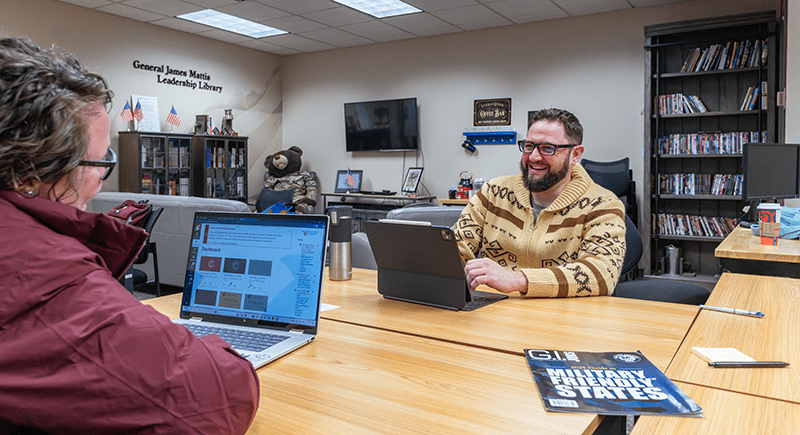
Regardless of where his journey leads next, Wilson credits his time at WSU Tri-Cities for providing a smooth transition from military to civilian life. For now, you can still often find him working at the Veteran’s Center, a campus space where he enjoys lounging, studying, and interacting with students from all walks of life.
“Some folks are veterans. Some folks would never join the military. And we all get along,” Wilson says with a smile. “It’s been a good couple of years of just interacting with the professors and the students and meeting people.”