




May 21, 2026 Hands-on STEM Discovery Day inspires young learners at WSU Tri-Cities
By Flynn Espe
The Washington State University Tri-Cities campus was buzzing with youthful energy and excitement as more than 170 visiting students from Finley Elementary School took part in a special STEM Discovery Day event on May 14. Throughout the morning, groups of students in grades three through five cycled through various labs and classroom spaces, each set up with a hands-on activity led by university faculty and staff.
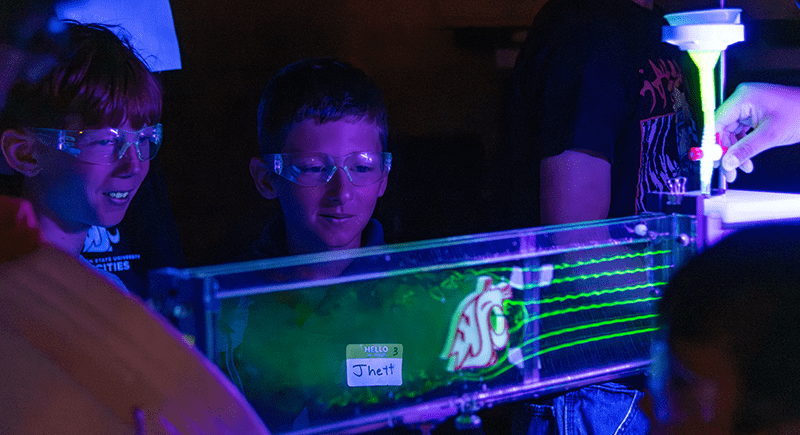
Groups of third-graders rotated through five activities involving rockets, perception, sensory play, decoder wheels, and the human heart. Students in grades four and five, meanwhile, explored 3D pens, robotics, electrical circuits, electronic music, and aerodynamics. Through it all, instructors prompted students to consider how science and technology play a key role in shaping the world around them.
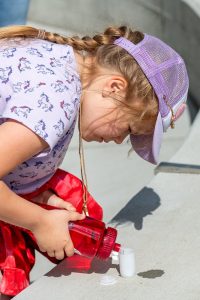
By mixing water and Alka-Seltzer tablets in a plastic film container, Finley Elementary third-graders launched makeshift rockets as part of a chemistry experiment.
Outside, in the campus amphitheater, Sara Egbert introduced a group of third-graders to rocket building by referencing NASA’s recent Artemis II mission, which sent four U.S. astronauts on a 10-day, 700,000-mile voyage around the far side of the moon and back.
“This rocket has to have super amazing fuel,” Egbert, a WSU Tri-Cities instruction and classroom support technician, said. “So there are engineers who make fuel that’s super-efficient and lightweight and won’t run out, because if you’re in space and your gas runs out, you’re in big trouble!”
Students then got to create their own miniature rockets with the help of a basic chemistry experiment: mixing water and Alka-Seltzer tablets to create carbon dioxide. By combining the ingredients in a sealed plastic film container, students stood back and watched as the pressure build-up caused their makeshift rockets to launch into the air with a satisfying pop. Egbert concluded by asking students what they might try in a future experiment to make their rockets fly even further.
“We need young scientists to come and help solve the problems in the world and to ask the good questions,” Egbert said. “So I hope you all go into science.”
Over in the Floyd building, Tyler Hansen, assistant professor of teaching and learning, taught a classroom of fifth-graders how to build electrical circuits using paper, copper tape, LED lights, and batteries.
“Circuits are how we carry electricity from one place to the other,” Hansen said. “They go only one direction, and specifically, it always goes from positive to negative.”
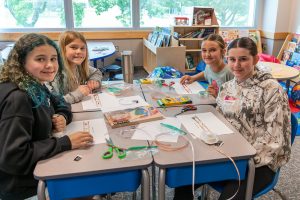
As part of the STEM Discovery Day, Finley Elementary fifth-graders learned how to build electrical circuits using paper, copper tape, LED lights, and batteries.
Student Alex Vasquez later cited Hansen’s activity as his favorite activity of the day, saying he enjoyed getting to see his experiment succeed after applying multiple red lights to the paper circuit.
“We got to turn on the lights without using switches,” Vasquez said.
Fifth-graders Tegan Bennett and Jace Gutzmer both enjoyed the music lab and 3D pen activity stations, where they combined STEM learning with creative expression to make beats and 3D-printed drawings.
“It was pretty fun,” Bennett said.
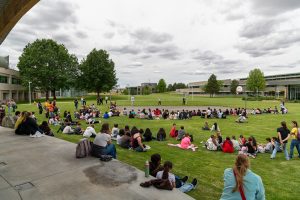
As the day’s events wrapped up, students gathered around the outdoor basketball court for one last demonstration led by Professor Joseph Iannelli from the School of Engineering and Applied Sciences, who quizzed the group on the difference between science and engineering.
“Science is about learning how nature works. Engineering is to take that knowledge and build items,” he said.
Demonstrating the relationship between science and engineering, Professor Joseph Iannelli and two of his students fly drones for Finley Elementary School students.
To illustrate his point, he produced a small remote-controlled drone as an engineered application of wind and force. Finley Students then got to watch as he and two university students flew drones around the space — cheering on as Iannelli carefully maneuvered his blue quadcopter through a basketball hoop.
The half-day event was made possible thanks to a generous grant from Women Helping Women Fund Tri-Cities (WHWF-TC), a nonprofit aimed at empowering women and children in the Tri-Cities region. The goal of the event was simple: Introduce young learners to the joys of STEM subjects in the hopes that some will go on to pursue science and technology professions later in life.
“You want kids to understand what the possibilities are for their future,” said Alysia Johnson, WHWF-TC executive director, who came to observe the opening and closing sessions. “This could help solidify what they want to do when they grow up, so these experiences are important.”
James Kindle, career connected learning coordinator for Educational Service District 123, agreed. As one of the outside organizers behind the event, he said the choice to target rural elementary school students was deliberate, noting that most STEM programs tend to focus on the high school age.
“And sometimes that’s more reactive than proactive, so with something like this this we’re planting the seed,” Kindle said. “We know that STEM is very important, especially for future jobs coming down the pipeline, and the more we can expose students to these types of activities the better. Because now they’ll go home and they’ll talk to their parents about the cool things that they got to do today.”