


October 1, 2026 From classroom to laboratory: WSU Tri-Cities alumna partners with BSEL research team
By Flynn Espe
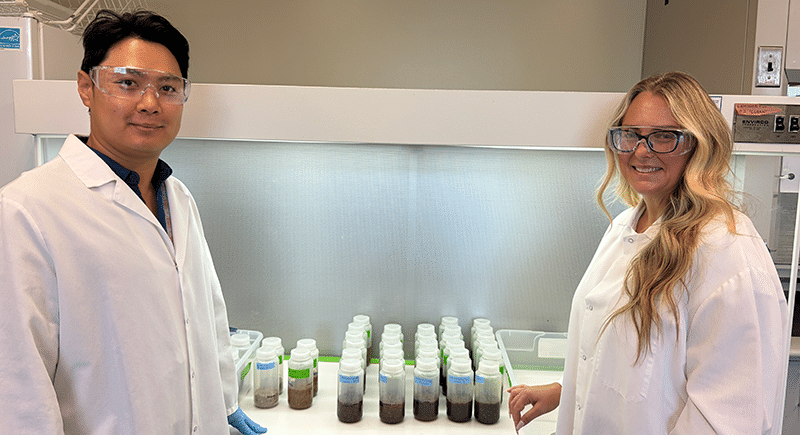
Eighteen years after earning her degree from Washington State University Tri-Cities, high school science teacher Katy Andrewjeski (’08 Elem. Ed.) found herself back on the Richland campus this past summer. Instead of learning about classroom management and teaching pedagogies, however, this time she was donning lab safety gear and helping researchers explore new methods for turning agricultural waste into bioplastics.
For two days a week over an eight-week period, Andrewjeski joined Professor Bin Yang and other researchers at the Bioproducts, Sciences, and Engineering Laboratory to observe and participate in their work.
The opportunity was made possible thanks to the M.J. Murdock Charitable Trust’s Partners in Science program, which allows middle and high school science teachers to engage in innovative research projects at leading science institutions under the guidance of a professional mentor. In doing so, partnering teachers gain authentic laboratory experience meant to elevate their classroom teaching on scientific processes and discovery.
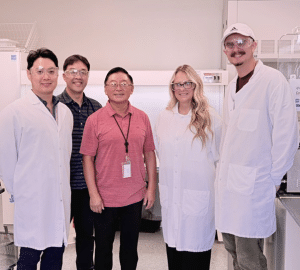
Left to right: Do-gyun Kim, Miki Santosa, Bin Yang, Katy Andrewjeski and Zach Johnson.
Under Yang’s mentorship, Andrewjeski conducted research on the bioconversion of agricultural residues, including corn stover and wheat straw, into high-value bioplastics and biofertilizers. Specifically, the research involved applying enzyme catalysts to the plant material as a first step in the conversion process.
“Their cell walls are made mostly of cellulose, hemicellulose and lignin, so the pre-treatments we were applying were meant to break down those [complex carbohydrates] into simpler, fermentable sugars,” Andrewjeski said.
By maximizing the number of fermentable sugars, she said, the plant waste becomes a more effective feedstock for certain bacteria that convert them into a polymer type known as polyhydroxyalkanoates, or PHAs for short.
“When people consume more sugar than their bodies need, the surplus is stored as fat. Similarly, some bacteria store excess carbon as PHAs, and PHAs can be used to make biodegradable plastics,” Andrewjeski said. “So the goal is to increase PHA production.”
For Andrewjeski, who teaches at Connell High School in rural Franklin County, the experience was particularly eye-opening. Not only does she live and work in a highly agricultural community, she also helps operate a family farm that recently switched over to corn and wheat production.
“I had no clue that corn stover and wheat straw, which are two waste products from our farm, could be used to produce biofuels or biodegradable plastics,” Andrewjeski said.
Whereas she and her husband have long focused on hay and cattle ranching, financial considerations caused them to change course last season.
“The hay market has not been the greatest, so we’ve had to pivot and make some other decisions — just trying to stay alive, which is not easy for a family farm these days,” she said.
As irrigation farmers, Andrewjeski says she and her husband typically pasture their corn stover after harvest before discing the remains back into the soil. Some growers sell their waste materials as feedstock, while others dispose of them through practices such as burning. But with biofuels and bioplastics becoming more commercially feasible alternatives to petroleum-based products, she said, farmers stand to benefit financially from the introduction of new markets.
At BSEL, Yang has played a significant role in making those economic changes possible, directing cutting-edge research efforts focused on converting agricultural residues, plant biomass and lignin into renewable fuels, chemicals and other high-value bioproducts. He was recently selected to Biofuels Digest’s The Bioeconomy 500 for 2026, highlighting the most influential global figures driving scientific and commercial progress toward biobased fuels, products and solutions.
Despite her lifelong love of science, Andrewjeski said she had never taken part in real-world lab research prior to participating in the Murdock-funded program.
“Most science teachers don’t have that experience, which is odd,” Andrewjeski said.
As such, much of her initial on-site training involved shadowing WSU Pullman graduate Do-Gyun Kim, a postdoctoral researcher who joined the BSEL team last spring after completing his Ph.D. in biological and agricultural engineering.
“She was very interested in the real research work, so I made sure to show her my workflow and explain the daily tests,” Kim said.
“Dr. Kim was great about showing me how to do everything,” Andrewjeski said. “There were a lot of people I would see periodically who would come through and make sure I had the help that I needed — Dr. Yang being one of them as well.”
The project was also beneficial for BSEL staff and faculty, as Andrewjeski and her husband — who also visited the lab at the end of the summer project — offered valuable insight from the agricultural business side of things.
Teachers selected for the Partners in Science program participate in two summers of research, as well as attend two Murdock-hosted conferences each year, including a January research symposium where they present their findings. With one summer under her belt, Andrewjeski plans to return to BSEL at the end of the current academic year to complete the project. In the meantime, she looks forward to bringing some of her lab experience into the classroom at Connell High School.
“That’s one of the things I’m most excited about, taking what I learned through my summer research and turning it into authentic learning experiences for my students,” Andrewjeski said.
One classroom project she’s already begun working on will mimic the work she did at BSEL by having students investigate the composition of plant biomass.
“Rather than simply teaching those concepts from a textbook, students could work through a simplified version of what I did in the lab — developing questions, making predictions, analyzing samples, collecting data and using that evidence to draw conclusions,” Andrewjeski said. “I want students to understand that science isn’t just about getting the right answer.”
To help facilitate that new curriculum, Andrewjeski was recently honored with WSU’s Ferrucci Distinguished Educator Award.
“I will be receiving funding for my classroom that I can use to purchase the lab equipment that we’re going to need,” she said.
On a deeper level, Andrewjeski says she also hopes to demonstrate to students how modern science and technology connects to the world around them.
“I hope my students see that the science they’re learning has applications beyond the classroom. It creates relevance, and that’s important to kids,” Andrewjeski said. “They can look at something as familiar as a cornfield and begin asking questions about chemistry, biology, sustainability, agriculture, engineering and how these things really do come together.”
Yang, meanwhile, plans to visit Andrewjeski’s classroom later this year to talk about his team’s work at WSU Tri-Cities.
“Katy and I hope this partnership will help bridge the gap between scientific discovery and STEM education, bringing cutting-edge research into the classroom and creating meaningful opportunities for both teachers and students,” Yang said.
In addition to her time in BSEL, Andrewjeski also returned to WSU Tri-Cities this summer as an online student in the Educational Leadership program. She’s currently seeking an add-on certification, with courses that she hopes will eventually contribute toward her doctoral degree.
“WSU Tri-Cities has given me so many opportunities — getting my education degree all the way to this program, so it’s a really big deal for me,” she said.