




May 1, 2026 WSU Tri-Cities exhibit explores the creative intersections of art and science education
By Flynn Espe
What do electronic quilts, fake sculpted dishes, and dried citrus fruits representing fractional math problems have in common? They’re all among the classroom-created works featured in a new Washington State University Tri-Cities art exhibit, one that explores an innovative teaching approach blending creative expression with traditional science and math curriculum — often referred to as STEAM (science, technology, engineering, art, and mathematics) education.
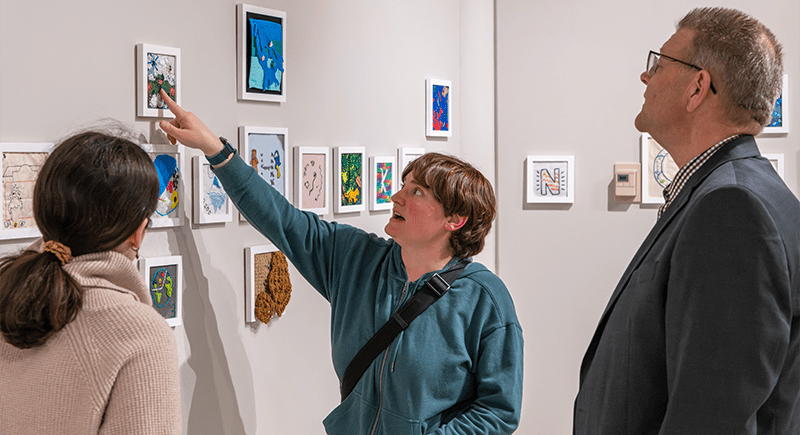
The exhibit, “Art(Math + Science) = Creative Intersections,” opened April 15 at the Art Center gallery in the Consolidated Information Center. It showcases works by WSU Tri-Cities education majors and local middle school students.
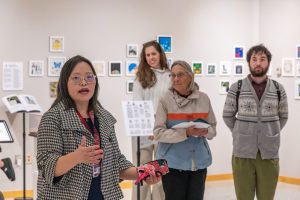
Yichien Cooper, assistant professor of teaching and learning, speaks during the exhibit opening for “Art(Math + Science) = Creative Intersections” on April 15.
Yichien Cooper, assistant professor of teaching and learning for the WSU Tri-Cities College of Education, Sport, and Human Sciences and the exhibit’s lead curator, has incorporated STEAM practices into her teaching and research for more than a decade. She also co-edited a book on the subject.
With the exhibit, supported by the WSU Fall 2025 Arts & Humanities Process Grant, Cooper hopes to demonstrate how creativity and critical inquiry can help students connect more deeply with science-based subjects — and sometimes reconsider topics they may have written off.
“We all bump into students who are hesitant to embrace art because they don’t think they are good at art, or students who are hesitant about math because math just doesn’t speak to them,” Cooper said.
Many of the pieces originated from Cooper’s “Integrating Fine Arts into K-8 Curriculum” course, where students complete a series of reflective art projects grounded in research and data. In one displayed assignment on food and consumption, students researched a dish, recreated it in sculptured form using homemade dough, and designed a nutrition label based on their findings, with a breakdown of ingredients and a short description.
The description for a piece titled “Asian Chicken Lettuce Wraps: Lettuce Turn Over a New Leaf,” by students Allie Ledezma and Taylor West, touts the benefits of using locally grown ingredients, which reduces carbon emissions resulting from long-distance transport. Another piece, titled “Killer Dog: The Dawg That Bites Back” by students Scotty Hunt and Ryan Jundt, recasts the traditional hot dog in vivid and unsettling form. Their description highlights several unsavory nutrition details, including a well-known study linking hot dog consumption to shortened lifespan.
“Each dish tells some sort of environmental awareness story that the student maybe never thought about before,” Cooper said. “And that’s what art is about. Art is making you think.”
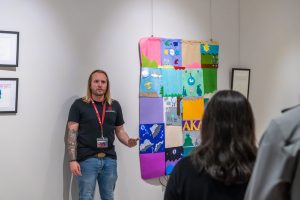
Tyler Hansen, assistant professor of teaching and learning, presents an electronic textile quilt created in his “Science Teaching Methods” course.
Cooper is joined in the exhibit by colleagues Tyler Hansen, assistant professor of teaching and learning, and Ethan Smith, assistant professor of mathematics — both of whom incorporate elements of STEAM education into their teaching.
For his portion of the exhibit, Hansen included an electronic textile quilt created in his “Science Teaching Methods” course. For that project, each student contributed a square representing a significant moment or life experience. In addition to felt designs, students incorporated colored blinking lights, hand coded to a microcontroller device.
“In order to make any of this work, you have to know how circuits work and how to make a complete circuit,” Hansen said. “We used conductive thread, so it actually carries a current to all of these lights.”
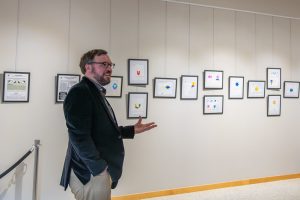
Ethan Smith, assistant professor of mathematics, showcases a project from his class in which students visualized basic math concepts using pattern block cutouts.
Smith, meanwhile, showcased a classroom project in which he prompted students to rethink basic math concepts using pattern block cutouts, giving them creative license to create new shapes and visual imagery from a “budget” of 12 triangle pieces.
“If a triangle is worth one and you have 12 dollars, or units, to spend, can you make a shape that’s worth $12 overall?” Smith said. “You see lots of different ideas and explanations of their strategies. Some students like to start with just the big hexagon and get six out of the way. Others want to have lots of little shapes.”
Like his faculty colleagues, Smith said he hopes to inspire future teachers to find similar ways of injecting creativity into their K-12 classrooms.
“I think there are a lot of great teachers out there who are doing this,” Smith said.
Destiny Kuespert, a former student of both Cooper and Smith who graduated from WSU Tri-Cities with her elementary education degree last December, is one teacher who’s taking those lessons and ideas to heart. She contributed to the exhibit with a display of pieces made by sixth grade students at Richland’s Carmichael Middle School, where she taught during her practicum experience last fall. Those pieces were previously featured in two separate STEAM exhibitions at the Reach Museum and Richland Public Library.
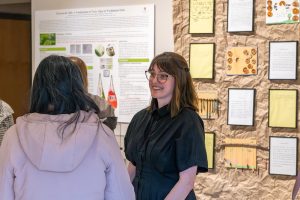
WSU Tri-Cities elementary education alumna Destiny Kuespert contributed to the exhibit with a display of pieces made by sixth grade students at Richland’s Carmichael Middle School.
For her classroom project, Kuespert’s students applied beads, dried fruits, and other crafting items to canvas as visual representations of fractional division. Kuespert said the students were free to decide the complexity of the math problem they wanted to solve, as long as they used one of two mathematical models to do it. Students who picked the number line method used sticks, strings, and beads, whereas students who chose the area or shape model used dried fruits to represent whole and fractional numbers. They also had to show their work in written form and reflect on their three-day project experience.
“You can read from some of their reflections how they felt. Some of them were saying, ‘This made me happy. I love doing art and math. Writing it out helped me understand it more,’” Kuespert said. “There were some that expressed, ‘I don’t like doing art,’ which is fine too. I was excited just to read all of their opinions.”
While traditional math and science curriculum exists for a reason, Cooper and her colleagues see art as an equally valid teaching method that can help preserve a student’s sense of wonder and curiosity.
“When I think back to early elementary school and math, I remember that being fun, joyful — creative activities. When I think towards middle and high school, math becomes more abstract. It becomes more pencil and paper,” Smith said. “I appreciated a lot of aspects of that, which makes sense where I ended up. But there’s no reason why that joy can’t sustain itself all the way through school.”
Kuespert echoed similar thoughts in describing the motivations behind her art-infused teaching projects.
“I wanted them to feel interested, because you see the worksheet so many times, it’s not interesting at all. You’re just thinking, ‘How fast can I get through it?’” Kuespert said. “I wanted them to see everything and feel intrigued. I think that’s the base of learning is you first have to be curious.”
Visitors to the exhibit can contribute to the gallery space as well through a series of self-guided creative math activities, also designed by the four collaborators and set up at multiple stations. The exhibit will be on display through the rest of 2026.