




April 22, 2026 WSU researchers test AI-driven spectral imaging for identifying recyclable plastics
By Flynn Espe
A new method for identifying types of plastics, built on advanced spectral imaging and machine learning, could make recycling more efficient and reduce landfill waste, according to a new study involving Washington State University researchers.
The method, described in a paper in the journal Resources, Conservation and Recycling, offers the promise of a sorting system that is more accurate in distinguishing and separating different types of plastics on conveyer belts, which is crucial for producing high-quality recycled materials.

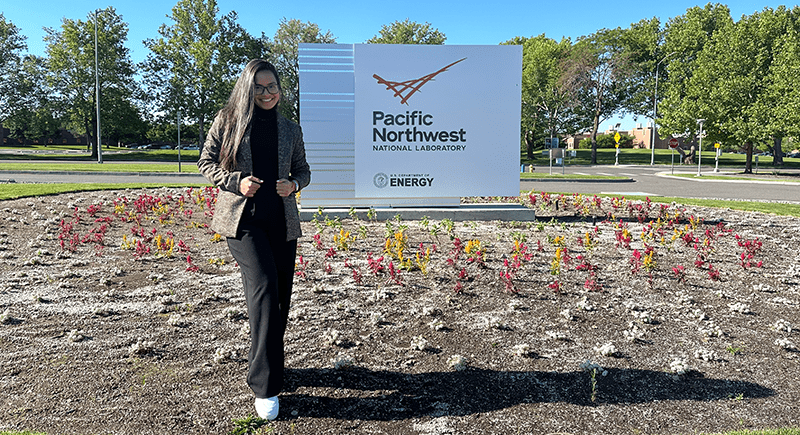
Maria Paula Garcia-Tovar, now a PhD candidate at WSU Pullman, previously worked as a research intern at Pacific Northwest National Laboratory in Richland, where she used the lab’s hyperspectral imaging equipment to gather data for a plastics identification experiment.
Maria Paula Garcia-Tovar, a Ph.D. materials science and engineering student at WSU Pullman, served as lead author. Macy Christianson (’22 BS Comp. Sci., ’24 MS Comp. Sci.), a WSU Tri-Cities alumnae now working at Pacific Northwest National Laboratory (PNNL); Luis de la Torre, associate professor of computer science at WSU Tri-Cities; and John Miller, emeritus associate professor of computer science at WSU Tri-Cities, were among the co-authors, alongside other colleagues from PNNL and the University of Puerto Rico–Mayagüez.
Spectral imaging builds upon the principles of spectroscopy — a technique for observing how light interacts with matter across different wavelengths. Using specialized cameras with spectroscopic sensors, spectral imaging machines detect and record spectral data for each pixel of an image. Analysis of that data can, in turn, identify the chemical composition or other properties of the materials. Hyperspectral imaging, which requires more sophisticated camera equipment than traditional spectral imaging, offers a higher level of resolution, providing a full spectrum at each pixel.
“It’s like a regular color image, which has red, green, and blue, but a hyperspectral image has a whole wavelength band — sometimes 3,000 wavelengths,” Miller said.
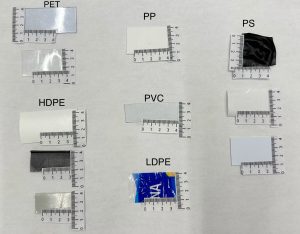
Maria Paula Garcia-Tovar collected several plastic samples from a Puerto Rican recycling center to be used in the scientific study.
For this study, the research team sought to investigate the feasibility of plastic identification in a simulation using hyperspectral imaging technology and convolutional neural networks (CNNs), a deep-learning artificial intelligence model often lauded for its ability to process complex image data. By training their CNN model on image data sets derived from two types of vibrational spectroscopies, the researchers determined both to be highly accurate in identifying six chemically distinct plastic types — with one model achieving 100% accuracy.
Although some recycling facilities have begun implementing hyperspectral imaging for plastic classification, most still rely on older, less accurate technologies such as near‑infrared sensors and RGB cameras. These systems are used during the sorting stage, after plastic loads have been screened for metal or other non‑plastic contaminants. Sensors mounted over fast‑moving conveyor belts capture and identify the plastics as they move past, and precision‑targeting air jets separate individual items by type.
Accurate sorting is important because different plastics have distinct chemical compositions and require specific processing conditions, including different melting temperatures. When plastics are improperly sorted, the quality of recycled materials can suffer, sometimes resulting in discarded batches that end up in landfills or incinerators.
Garcia-Tovar said the plastic samples used in the study were recovered from a recycling center in Puerto Rico, which made successful identification of the materials more challenging but also more reflective of real-world conditions.
“These plastics are real plastics, so they had some environmental degradations,” Garcia-Tovar said, adding that some samples were even discolored from additives, making them harder to identify with older technologies. “But the model was successful.”
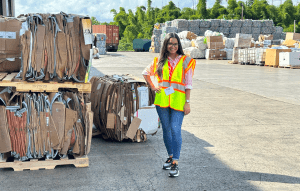
Maria Paula Garcia-Tovar collects plastic samples in Puerto Rico while pursuing her master’s degree.
Garcia-Tovar, who is originally from Colombia and has a background in industrial engineering, was initially recruited to the project while pursuing her master’s degree at the University of Puerto Rico–Mayagüez, working under the guidance of co-author Samuel P. Hernández-Rivera. She collected the samples and provided infrared spectral imaging data using equipment at her university. She then brought the samples to PNNL, where she worked as a research intern during the summer of 2024, using the lab’s high-end imaging equipment to obtain the rest of the hyperspectral images for the machine learning experiment.
According to Miller, who worked on the machine learning framework, there were certain essential functions that had to be implemented for the experiment to work. One of the first tasks, he said, was getting the image analysis software to isolate and identify each plastic item within each spectral image.
“One of the weird things is that the conveyor belt is also plastic, so you have to distinguish the [recycled] plastic from the conveyor belt as well,” Miller said.
Another challenge Miller pointed to was optimizing the computational process so that it matched the speed of a fast-moving conveyer belt. A potential future step, he said, would be to test the imaging framework on a physical conveyor system.
Garcia-Tovar, for whom this is her first published paper as lead author, said she decided to further her education at WSU based on her positive PNNL internship experience. She says another paper from her PNNL internship is forthcoming — this one dealing with microplastics.
“I am very happy to continue studying at this university,” she said. “This experience has been really amazing.”