




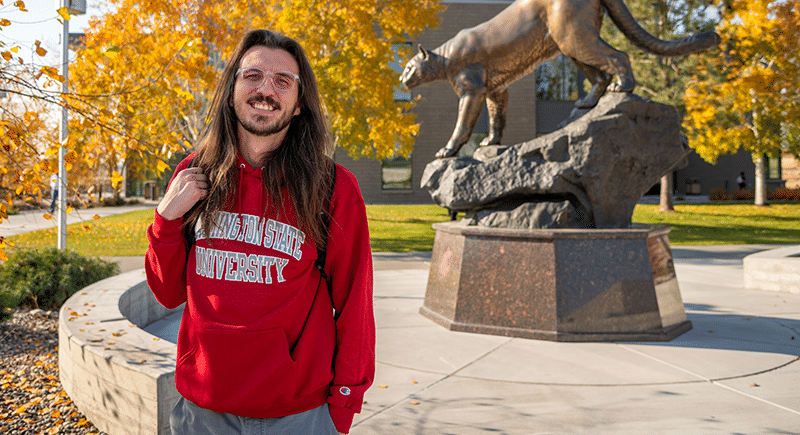
November 10, 2026 Taking the leap: How Army service led Cheyne McDermott to a new mission
By Flynn Espe
Washington State University Tri-Cities student Cheyne McDermott knows what it’s like to step into the unknown, both literally and figuratively. As a U.S. Army paratrooper with the 82nd Airborne Division from 2020 to 2023, he jumped from low-flying military aircraft on multiple occasions, trusting his training to guide him safely to the ground. Most jumps took him over drop zones in the United States. One carried him across the Atlantic.
“It was some of the most fun I’ve ever had in my life,” McDermott said. “I got to explore, travel the world.”
Today, the senior psychology major is pursuing a new mission. After four years of military service, he’s stepping toward a career built on helping others — drawing on lessons learned through military life, personal hardship and his own journey of self-discovery.
“I’ve personally been transformed by the therapeutic process,” McDermott said. “If I can help people and provide that for others, that would be so rewarding.”
A call to serve
Long before he was studying for midterms — let alone parachuting from planes — McDermott was searching for a path forward. Growing up in San Diego, he dropped out of high school during his sophomore year and later earned his GED. After years of working at unfulfilling jobs and struggling to pay rent in a high-priced housing market, he knew he needed to make a change.
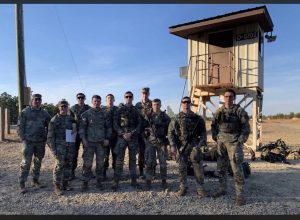
As a member of the U.S. Army 82nd Airborne Division, Cheyne McDermott (pictured far right) was stationed at Fort Bragg in North Carolina.
“I wanted to go to college, but unfortunately with my prior decisions, there were some hurdles in the way,” he said. “The idea of going to school and having to balance a job just seemed unfeasible.”
Military service had always been in the back of his mind. His grandfather who served during the Vietnam War, a close family friend who served and died in Iraq, and growing up in one of the country’s largest military communities all influenced his decision to enlist.
When he signed a four-year Army contract at age 23, he did so with a practical goal in mind: Gain some skills and discipline through service, then move on to college. At the same time, he was open to seeking some thrills along the way.
“I wanted to do something for four years that I would never be able to do in the civilian world, and that’s shoot guns and jump out of airplanes,” he said.
Earning his wings
His military experience got off to an unusual start. Just weeks after arriving at basic training in February 2020, the COVID-19 pandemic began, with recruits being largely cut off from outside news.
“It felt like I was in the beginning of a zombie movie,” he said with a laugh.
After boot camp and Advanced Individual Training, McDermott spent three weeks at the U.S. Army Airborne School in Georgia, where he trained for and completed his first five parachute jumps.
While each jump delivered its own adrenaline rush, an awkward execution on his final training drop drove home the reality of his new profession.
“I didn’t jump out as vigorously as I should have, so I kind of slapped the skin of the aircraft and tumbled a few times,” McDermott said. “I remember falling back and waiting for my chute to open and seeing the plane fly away. … It took five jumps for me to finally realize, ‘Oh, I just jumped out of that. That was real!’”
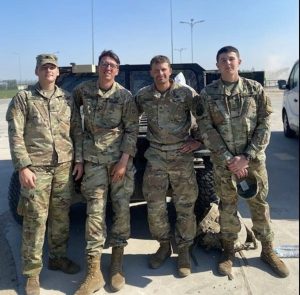
Cheyne McDermott (second from left) traveled to Estonia during a two-week NATO training exercise in 2021.
For the bulk of his Army contract, McDermott remained stationed at Fort Bragg in North Carolina. Although he had initially wanted to enlist as a standard infantryman, his recruiter had steered him toward a more technical role of fire support specialist. In that role, he learned to coordinate artillery, mortars, air support and other weapons strikes for infantry units.
“Basically, I’m the guy that’s gathering all the targeting data and calling it in,” McDermott explained.
He later reached the rank of sergeant.
Among his most memorable assignments were two overseas ventures in Europe, including a 2021 NATO training exercise in Estonia that saw him parachuting onto an foreign airfield after a 14-hour flight, as well as a five-month deployment to Poland after Russia’s invasion of Ukraine in 2022.
“I got to see a lot of the Ukrainian refugees coming from the east, and it was a surreal experience,” McDermott said. “It really put into perspective the kind of life and culture I grew up in.”
Highs and lows
Military service also transformed McDermott’s life in more personal ways. He met his wife, originally from Othello, Washington, at the Military Entrance Processing Station in Spokane, as the two were both shipping off to basic training.
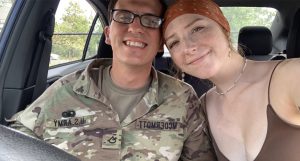
Cheyne McDermott and his wife Rhiannon first met at the Military Entrance Processing Station in Spokane.
“I went to South Carolina and she went to Oklahoma, so I thought I’d never see her again,” McDermott said.
On the contrary, the two reconnected weeks later, started dating and got married soon after.
A less fortunate event occurred in February 2023 when McDermott completed the 10th and final parachute jump of his military career — one that ended with a particularly jarring landing.
“It was just a windy day, poor jump,” McDermott said. “I hit my head pretty bad.”
Though he brushed it aside in the moment, it was McDermott’s wife who picked up on his off-kilter behavior when he arrived home later that day. She brought him to the emergency room, where a doctor determined he had suffered whiplash and a traumatic brain injury. Though therapy aided his recovery, he still experiences chronic migraines and tension headaches.
The injury ultimately solidified his decision not to reenlist.
“I had been hemming and hawing about staying in,” McDermott said. “In the end I decided, ‘You know what? I’m not getting any younger. I’m going back to my original plan.’”
From Army sergeant to college major
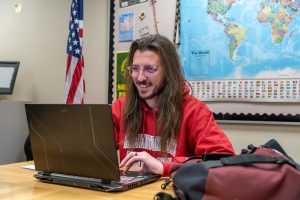
A senior psychology major, Cheyne McDermott hopes to pursue a career in clinical counseling.
That fall, McDermott and his wife moved to Richland, where they could be closer to her family. After leaving active duty in August 2023, McDermott began taking classes at WSU Tri-Cities just days later.
He intended to major in computer science, but it was a first-semester elective course that quickly captured his attention and caused him to switch.
“I took intro to psychology and just fell in love with the material. It was extremely interesting,” McDermott said. “I was able to learn a lot about myself through that class.”
With graduation on the horizon, he says he’s now considering graduate school and a doctorate degree.
“I have a very heavy interest in the clinical element of it. I’d like to one day work at the VA or work with veterans,” he said, noting a particular interest in helping patients with post-traumatic stress disorder and substance abuse. “I’ve unfortunately had a lot of people in my life, both inside and outside the military, who have struggled with that.”
Service beyond the uniform
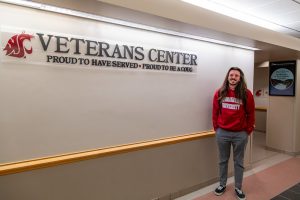
At WSU Tri-Cities, Cheyne McDermott has worked multiple campus jobs, including as a student worker for the Veterans Center.
Despite his positive student experience, McDermott is the first to admit that the transition from military to civilian life hasn’t always been easy. With new routines, less daily structure and a separation from the camaraderie of other service members, he says, it can take time to adjust.
“Being separated from that was really hard for me initially,” McDermott said. “I felt kind of lost.”
Ultimately, it was other WSU Tri-Cities veterans, including student workers at the campus Veterans Center, who helped him feel welcome and supported.
“I kind of call it the veterans’ safe space. It’s a place for veterans to come in, study, create community,” McDermott said. “Every time I’d come in here, the conversations I would have with people reminded me of those times that when I was in, and it helped to bridge that gap.”
Now employed by the Veterans Center himself, McDermott enjoys helping other veterans navigate that transitional phase as well.
Though his days of jumping from military aircraft may be over, he continues to take leaps of faith in other ways. And while the mission looks different, he’s still driven by the same desire to grow and serve the people around him.
“I think WSU Tri-Cities offers a unique experience because we are a smaller campus. The ability to build community here is so readily available,” McDermott said. “I’ve been afforded opportunities here that I never saw myself doing.”