




December 8, 2025 Nursing graduates celebrate new beginnings at fall 2025 pinning ceremony
By Flynn Espe
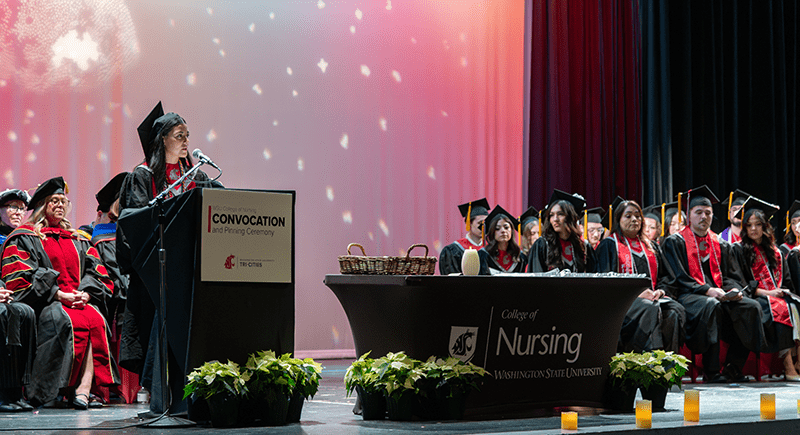
It was an evening of gratitude and reflection as 28 soon-to-be graduates from the Washington State University Tri-Cities Bachelor of Science in Nursing (BSN) program gathered on the auditorium stage at Chief Joseph Middle School in Richland last Thursday.
As part of the BSN Convocation and Pinning Ceremony for the graduating class of fall 2025, each student was there to receive two symbolic items marking their passage into a time-honored profession. The first was a small pin bearing the image of a burning oil lamp, an emblem dating back to the stories and historical traditions of Florence Nightengale. The second, also a symbol of illumination, was a lighted candle.
“Some of you may choose to stay and serve in this region. Others may take your talents elsewhere,” Anne Mason, interim dean of the WSU College of Nursing, told the students. “But wherever you go, you are prepared.”
As the chosen BSN student speaker, Edith Nateras reminded her peers of the long journey that had brought them to that moment.
“We battled through sleepless nights, caffeine-fueled study sessions and clinicals that started so early, even the sun wasn’t ready to clock in,” Nateras said. “The truth is that through the hardest moments, we found strength. We learned that nursing is not just about knowledge but about compassion. It’s not just about long shifts but about long-lasting impact. It is not just a career—it’s a calling.”
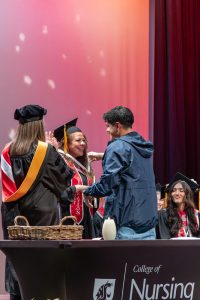
Maria Valle chose her eldest son to pin her.
The students were joined by a crowd of family, friends, mentors and supporters—some of whom were there to serve as “pinners” tasked with placing the lamp pin onto the gown of a student who had pre-selected them. As each student’s name was called, their designated pinner also came to the stage to present the emblem, often followed by a congratulatory embrace.
For Maria Valle, it was her oldest son Leo, the middle child of five siblings, who placed the pin on his mother.
“I wish I could have chosen all five of my children. But I’ve chosen Leo, my firstborn son, to place my pin because he, along with his two older sisters, Ellie and Julie, have walked beside me through this entire journey,” Valle said prior to the ceremony. “They all truly understand what this moment means, not just for me but for our entire family. It signifies breaking boundaries and overcoming social adversity.”
Some of the students chose a parent or grandparent as their pinner. Others chose siblings, spouses or significant others. Dakota LeVine selected one of his faculty mentors.
“I have chosen Clinical Assistant Professor Ameera Fayad to place my pin,” LeVine said. “I want to be like her when I grow up.”
Nateras received her pin from her 7-year-old daughter.
“I want her to know that this accomplishment is for both of us,” Nateras said. “I chose this career path not only to better my life but to give her more opportunities than I had. I want her to see that anything is possible when you commit yourself.”
In addition to the pinning ceremony, two awards were presented to students who went above and beyond. LeVine received the annual Pre-Licensure BSN Clinical Excellence Student Award for his outstanding work ethic and professionalism, and JT Wegner received the Outstanding Pre-Licensure BSN Student Award.
According to Christina Chacón, the academic director for WSU Tri-Cities College of Nursing who presided over the ceremony, the pinning ceremony remains an important rite of passage for many nursing education programs around the world. The event is particularly meaningful to her, she said, because she too received her nursing pin as a WSU Tri-Cities BSN graduate in 2008 before going on to receive her master’s and doctorate degrees from WSU Tri-Cities as well.
“It’s a real full-circle moment for me,” she said. “To be here as the academic director is such an honor. But on top of that, to be able to play a part in their journey, I can’t even tell you—it’s a very emotional process for everybody.”
In order to enter the BSN program, students must first complete roughly two years of prerequisite courses, including anatomy, chemistry, microbiology and physiology. Then, upon being selected, it’s a rigorous combination of academic and clinical experience, part of which is accomplished in a simulated environment at the College of Nursing building in downtown Richland, which for the fall semester expanded its simulation capabilities with a brand-new series of mock exams rooms. Outside the classroom, students also take part in a series of worksite placements at partnering medical facilities, where students gain several hours of critical hands-on practice working directly with patients.
While their initial placements take place at long-term care facilities, students eventually move on to working in hospitals and other clinical environments—such as psychology, pediatrics, and obstetrics and gynecology clinics. By their senior year, students choose a desired clinical field for their senior practicum placement. Faculty, in turn, work to match them with an appropriate facility.
“When I did my senior practicum, I asked for my placement to be within psych. Other people might say, ‘OK, I want to do my time in emergency medicine, or I want to do it over here in mother-baby practice,’” Chacón explained. “That really is a signal to the focus of a person’s interest.”
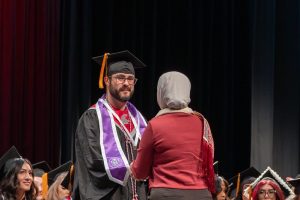
Dakota Levine was pinned by faculty member Ameera Fayad.
Before entering the BSN program, LeVine served for almost eight years as a hospital corpsman in the U.S. Navy—a period that saw him stationed in Illinois, California and Japan. While his duties changed over time, it was during his final years of service at Naval Hospital Okinawa that he worked as an emergency medical technician, among other roles.
“Working alongside nurses in the emergency department was the first time I considered becoming a nurse,” he said. “I always loved the hands-on and direct patient care throughout my career.”
He now plans to pursue a career as a registered nurse practitioner in a hospital emergency department.
“There have been several patients who have told me I will be a great nurse based on my attentiveness and compassion,” LeVine said. “Family, friends and classmates see me on my best and worst days and are unwavering in their support, but to have patients who I would see briefly express their gratitude towards me is an even greater motivation to keep going.”
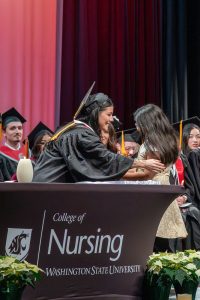
Edith Nateras was joined on stage by her daughter.
Nateras said she was drawn to helping others from a young age and previously considered a career in pediatrics.
“As I grew older, I realized how closely nurses work with patients and how essential they are in providing hands-on care,” Nateras said. It was her older sister, a prior graduate of the Registered Nurse to BSN program at WSU Tri-Cities, who nudged Nateras down a similar path. “She motivated me to apply to the WSU program, and I’m so grateful that I did.”
Having accepted a full-time position in the emergency department at Prosser Memorial Health, Nateras said she looks forward to the next phase of her career.
“I thrive in the fast-paced environment—the adrenaline, the critical thinking and the challenge of uncovering what’s making a patient ill,” Nateras said, adding that she also hopes to one day become a sexual assault nurse examiner. “I want to advocate for individuals who may feel they don’t have a voice.”
As the single mother of five, Valle credits her faith in God and the support of her five children for sustaining her through to graduation. She also expressed gratitude for financial support she received as a recipient of the Soroptimist Live Your Dream education grant, given to women who are the primary financial providers for their families, as well as a Richland Rotary Club scholarship.
“Both of these honors not only helped relieve a big part of the financial pressure of school and work but also made me feel seen and supported by my community, reinforcing that my hard work and goals matter,” Valle said.
Valle said she plans to pursue her career in an intensive care unit and emergency department, gaining enough experience to eventually further her education as a certified registered nurse anesthetist.
“Looking back, this journey hasn’t been easy, but it has shaped me in ways I never expected,” Valle said. “I’m grateful for the all people who stood by me.”
With nursing school now out of the way, Chacón says the graduates are ready to take the National Council Licensure Examination (NCLEX), the standardized competency test for new nurses, whenever they feel ready. Fortunately, Cougar nursing students tend to do very well, she said, citing an impressive 95.8 percent NCLEX passing rate for WSU Tri-Cities BSN graduates in 2025.
From there, the possibilities are unlimited.
“You can be a nurse on a cruise ship. You can be a flight nurse in a helicopter. You can be a school nurse. You can be a telephone triage nurse. There are so many different ways to be a nurse,” Chacón said. “So if you feel like your direction is going a little bit stale, you can pivot and reinvent yourself within the career itself.”
Moreover, she says, it’s a profession that’s never turning good candidates away.
“There’s always a demand for nurses—always,” Chacón said. “As specialties and needs continue to evolve, we always have a need for nurses.”