



February 27, 2026 New SMR Simulator Boosts Nuclear Education and Workforce Development in the Tri-Cities
By Flynn Espe
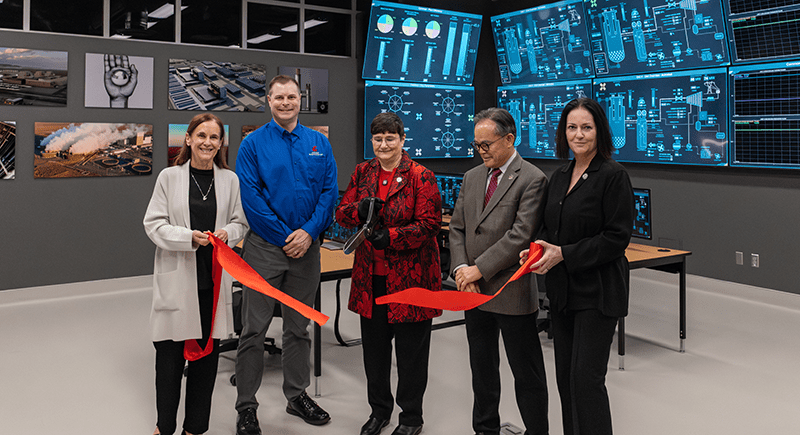
The Washington State University Tri-Cities Institute for Northwest Energy Futures (INEF) hosted a packed-house event on Wednesday, as community leaders from education, energy, and other local industries gathered to celebrate the launch of an educational small modular reactor (SMR) control room simulator.
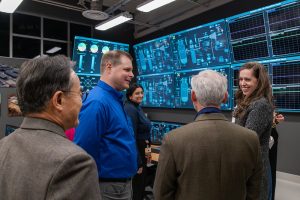
Students from WSU and Columbia Basin College will be able to simulate the control operations for a small modular reactor based on X-energy’s Xe-100 advanced nuclear technology.
The simulator is housed at the INEF building and will be operated in partnership with Energy Northwest and Columbia Basin College (CBC). Developed with funding from the U.S. Department of Energy’s Community Capacity Building Grant Program, the space is designed to advance workforce readiness in advanced nuclear energy and strengthen the pipeline of skilled talent needed to support the region’s growing energy sector. Students will gain hands-on experience with operational scenarios modeled on X-energy’s Xe-100 advanced SMR technology.
“We are thrilled to be a partner in this effort to expand education and outreach within the rapidly growing field of advanced nuclear energy,” said Sandra Haynes, WSU Tri-Cities chancellor. “This program is especially relevant to this region given the strong nuclear presence and planned future expansion. Preparing the workforce for these next-generation SMR facilities will require collaboration, commitment, and forward‑thinking initiatives like this one.”
Students from both WSU and CBC will have access to the technology as part of their academic programs. The simulator is also expected to provide scenario training for Energy Northwest employees, while also serving as a site for community outreach visits aimed at educating the public on advanced nuclear energy.
“Collaboration with industry and higher education partners is critical to ensuring we develop a local workforce to support our community today and in the future,” said Rebekah S. Woods, CBC’s president. “We know that practical, hands-on experiences are key to helping students discover career pathways they may not have considered before.”

WSU Tri-Cities Chancellor Sandra Haynes gives remarks at the Feb. 25 open house event celebrating the launch of the advanced nuclear simulator at the Institute for Northwest Energy Futures building.
In 2024, Energy Northwest announced an agreement with Amazon and X‑energy to build up to 12 small modular reactors, called the Cascade Advanced Energy Facility, near Energy Northwest’s Columbia Generating Station — the Pacific Northwest’s only commercial nuclear power plant. The Cascade facility is expected to create up to 1,000 temporary construction jobs and at least 100 permanent positions once fully operational.
For WSU students, the SMR simulator will provide a powerful applied-learning component to existing coursework in mechanical engineering, energy dynamics, and nuclear science. WSU Pullman has a 1-megawatt TRIGA research reactor and certificate programs in nuclear materials, science, and engineering that provide additional pathways into nuclear energy studies and careers. Going forward, Pullman students in those fields will have opportunities to visit the Tri-Cities to use the simulator, and the reactor operations program will likewise be expanded to incorporate students from the Tri-Cities campus — providing hands-on education and exposure to traditional and advanced nuclear technologies alike.