




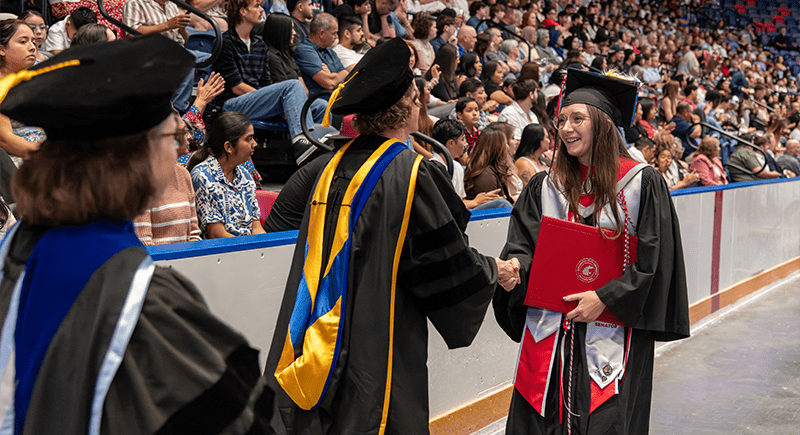
May 20, 2026 Chasing bees and crafting community: environmental science grad finds her colony at WSU Tri-Cities
By Flynn Espe
Washington State University Tri-Cities graduate Rachel Holland spends a lot of her time thinking about the little things — specifically, insects. She also enjoys sharing her fascination for these six-legged invertebrates and their remarkable biodiversity with others.
“There are parasitoids who lay their eggs in other insects, bees that sneak their eggs into other bees’ nests,” Holland says. “There are ants which wage wars with termites, sneaky beetles who find ways around their rivals for mates, and bees that turn rotting flesh into honey. I don’t think I’ll ever learn everything about them, which is exciting.”
That chitinous curiosity is shaping her next big step. Having just completed her bachelor’s degree in environmental and ecosystems sciences, she’ll be continuing this fall as a WSU graduate student in the Master of Science in Entomology program, conducting research on native bees through the Irrigated Agriculture Research and Extension Center in Prosser.
“My specific research will be on alfalfa fields,” she says. “I’ll be going to Walla Walla half the time and then to Prosser to see if the pesticide that they’re using is harmful at a greater rate than another pesticide they’re using on the leafcutter bees and the alkali bees.”
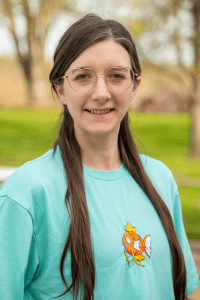 Her path to this moment has been a rewarding, if not quite typical, one. As a nontraditional, first-generation college student, Holland’s first attempt at college ended on a sour note. After graduating from high school in 2007, she went straight into taking classes at Columbia Basin College, but with little motivation or direction, her grades suffered and she dropped out shortly thereafter.
Life moved on. Holland got married and soon focused on raising a family. While her husband went to trade school and into the workforce, Holland worked as a stay-at-home mom and embroidery artist, selling intricate craft pieces both locally and online. Eventually, Holland decided she was ready to pursue a college education — and hopefully find her career passion — once again.
Although the plan was always to start at CBC and finish her bachelor’s degree at WSU Tri-Cities, she didn’t begin with environmental studies in mind.
“I originally was going to do elementary education with a history minor,” Holland says.
Her academic focus began to shift when she found herself unexpectedly enjoying two lab classes during her final CBC quarter. One was an environmental science lab that involved growing wheat under various conditions. The other was an entomology lab, which included a final assignment that had students catching insects in the wild and pinning them for identification.
“As soon as I had that net in my hand, I was ready to go,” Holland says. “The hands-on part of it really transformed how I saw the world, and I thought, ‘I can actually do science.’”
Not content simply to pass her classes, Holland succeeded in graduating from CBC with honors — no easy task, considering she was still carrying her 2.0 GPA from years earlier.
“I had to drag that 2.0 out of the mud,” Holland says.
Arriving at WSU Tri-Cities, her momentum continued. Having switched majors, Holland found that environmental and ecosystem sciences offered a satisfying blend of physical science with coursework exploring the delicate interplay between manmade and natural systems.
“It covers so many bases but includes the human aspect of it, which is what I really like,” Holland says.
Outside of class, she began building friendships and community wherever she went. She got involved in campus clubs, serving in leadership roles such as Environmental Club event coordinator and co-president for the Women in STEM Club.
As a senior, she also served as the Associated Students of WSU Tri-Cities senator for the College of Agricultural, Human, and Natural Resource Sciences, advocating for students on a range of issues like campus recycling and a native plant garden for hands-on learning.
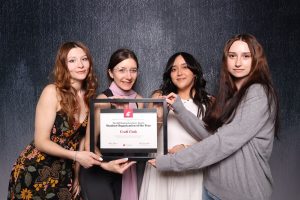
The WSU Tri-Cities Craft Club, which Holland co-founded, won the Student Organization of the Year award in 2025.
One of Holland’s proudest accomplishments involved joining up with friend and classmate Evalena Dalsbo to launch and nurture a brand-new campus Craft Club, where they and others could share and spread their love for the crafting arts. The club grew in popularity as students of all backgrounds met up for sewing, sculpting, embroidery, and other seasonal craft projects. Their team went on to win the “Student Organization of the Year” award at the 2025 Student Excellence Awards.
“That club is really fun because everybody can come in there — engineers, psychology majors, English majors, people I would not meet in classes,” Holland says.
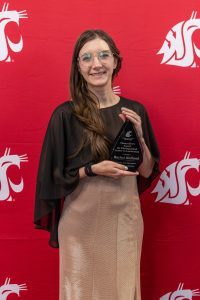
Last May, Holland was honored as a recipient of the 2026 WSU Tri-Cities Award for Distinguished Career in Leadership.
Alongside her club involvement, Holland gained additional experience as a lab teaching assistant and student intern for the Institute for Northwest Energy Futures’ Energy Ambassadors Network. It all added up to Holland being honored last month as one of three recipients of the 2026 WSU Tri-Cities Award for Distinguished Career in Leadership.
If it all sounds like a lot to juggle, it was. Fortunately, Holland says, she had a strong support network — including her husband and two kids, now in the fourth and sixth grades.
“It’s definitely been a group effort,” she says.
She also credits the helpful guidance she received from the WSU Tri-Cities TRIO Student Support Services team.
Case in point, Holland says she still recalls the stress and uncertainty she felt at the beginning of her junior year, when an overpacked course load had her questioning her degree path. “I was taking an ecology lab, statistics lab, and organic chemistry lab — and then another class that did not have a lab attached to it,” Holland says. “That was, on paper, only 15 credits.”
Not knowing if she’d made a poor scheduling decision or simply needed to push through, Holland says a drop-in meeting to the TRIO office brought her clarity and relief. TRIO staff confirmed she’d taken on an unusually heavy course load and walked her through the steps of how to revise her schedule.
“I couldn’t have made that decision without TRIO being like, ‘You’re not insane. This is actually really hard what you decided to do,’” Holland says.
TRIO staff came through again this past year when she was still considering grad school. By talking through the process and working with staff on a step-by-step plan, Holland felt better prepared to ask her professors the right questions and ultimately apply.
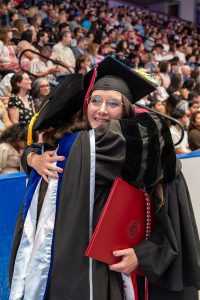
Having completed her bachelor’s degree in environmental and ecosystems sciences, Holland is continuing her academic journey as a WSU graduate student in the Master of Science in Entomology program.
Now, as a graduate student, Holland says she’s looking forward to doing more of what she loves — exploring the vast world of insects and engaging with other scientists in a laboratory setting. She’s also excited to be working at the intersection of ecology and agriculture.
“A major component of agriculture is insects, whether that is beneficial or pest,” she says. “I can see myself continuing to do research and make changes at the government level like in the Washington State Department of Agriculture or through education.”
When asked about advice she has for others starting their own college journey, Holland encourages students to seek out professors for academic and career advice and to take advantage of new opportunities.
“Go to meetings that you probably don’t think you belong in. Go to an engineering meeting even if you’re not an engineer,” she says. “If you see an opportunity and you think, ‘I might want to do that,’ just do it. What’s the worst that can happen?”