



May 4, 2026 Student research and creativity shines across more than 65 projects at annual showcase
By Flynn Espe
More than 120 Washington State University Tri-Cities students presented their academic projects Wednesday at the annual Showcase for Research and Creative Activities. This year’s event brought together more than 65 solo and group projects spanning multiple majors and disciplines.
Across three campus buildings, students set up scientific posters and, in some cases, hands-on demonstrations of their work as they chatted and mingled with other students, faculty, and community guests.
Read or click here to jump to the end to view the winners and honorable mentions.
Solving energy problems near and far
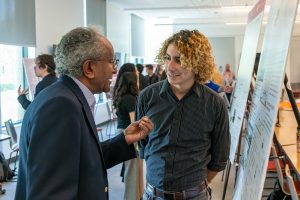
Institute for Northwest Energy Futures intern Hasan Cruz discusses his research with WSU Tri-Cities emeritus professor Mohamed Osman.
Presenting from the first floor in Collaboration Hall, Hasan Cruz, student intern for WSU Tri-Cities’ Institute for Northwest Energy Futures, presented his research involving pumped storage hydropower as a partial solution to the problem of peak power grid demand.
“It’s a huge water battery that stores long-duration potential energy and then releases it when it is needed the most during peak hours of the grid,” Cruz said. “So the grid gets stressed and we need to meet demand, because people seem to forget that electricity is something that we need absolutely every second.”
He conducted his research under the mentorship of WSU Tri-Cities alumnae Danielle Young (’19 BS Civ Eng, ’21 MS Civ Eng), a project manager at Battelle. As a civil engineering major, Cruz says he was thrilled to discover the strong connection between his field of study and the energy industry.
“When I started my civil engineering major, I thought it was only construction,” Cruz said. “It turns out there’s so much more, and energy is one of those fields that I never thought would be possible.”
A few spots over, fellow INEF intern and biology major Zoe Pfeifer summarized her research into fusion technology. She noted that Washington state is a major hub for companies at the forefront of fusion machine design and development, and breakthrough discoveries may be closer than we think.
“We already have a lot of policy in place to help entice companies to come here,” Pfeifer said. “Even globally, there are 160 fusion facilities being worked on right now worldwide.”
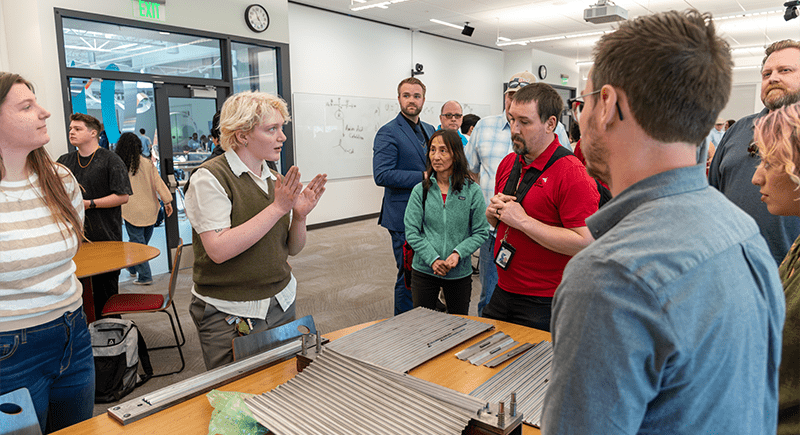
A showcase judge from Hanford Tank Waste Operations & Closure examines the plastic model of a heat waste radiator for a small modular reactor on the moon.
In a separate showcase room, a group of students had a plastic model showing their proposed designs for a much different kind of energy problem: how to deal with heat waste from a small modular reactor on the surface of the moon. Those students — Kaamel Ahmed Sidiqi, Minh Vu, Sam Arthur, Jon-Luc Ritchie, Peyton Viera, and Stephanie Volatile — presented their mechanical engineering senior capstone project, in which they worked under the guidance of an industry sponsor at Framatome.
“As we’re getting closer to interplanetary travel, we’re looking into building habitats elsewhere in the solar system, specifically the moon or Mars, currently. They’re planning on using small modular reactors — around 100 kilowatts thermal, or so — to power these habitats,” Viera said. “The issue with that is you can only utilize so much energy from these reactors before it just becomes a byproduct.”
With a specific target in mind — safely dispersing 74 kilowatts of wasted heat into the moon’s vacuum-like environment — the group did a deep dive into whatever research they could find that would help get them started.
“Our sponsor had us look into NASA research papers, private industry papers, and university papers,” Volatile said. “I personally used a lot of the library sources that WSU gave us to point us into the private industries and try to get as much as we could.”
Eventually, the team settled on a folding-aluminum-panel radiator design that fit within the specifications for being deployed and assembled on the lunar surface.
“Same type of thing for a car — it has a radiator,” Ritchie said. “This is just a radiator for a nuclear reactor.”
Protecting online systems and spaces
Meanwhile, multiple students and teams were showcasing their research into methods and ideas for improving or addressing threats to online and computer systems.
Computer science majors Jaydon Larios and Tyler Jase Schab walked visitors through their development of a web platform that evaluates the vulnerability of a user’s password by simulating multiple cracking methods.
“The system processes each password through different hashing algorithms,” Larios said. “It estimates the actual time it would take to crack these passwords.”
It turns out, short and common passwords really do take mere seconds for would-be attackers to crack.
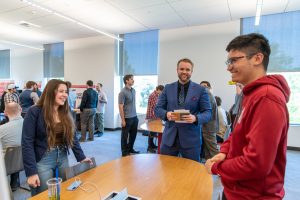
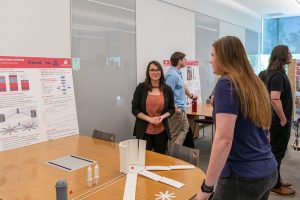
A showcase judge from Pacific Northwest National Laboratory connects with students Yozelyn Chavez and Luckie Devers about their proposed solution to personal information leakage in large language models.
Nearby, Yozelyn Chavez and Luckie Devers talked about their approach to preventing leakage of personally identifiable information in large language models, or LLMs for short. They represented half of their capstone project team, which also included Gabriela Nicacio and Alan Valencia who were studying abroad in Sweden.
“Basically, if you’ve ever entered in your information, even just your first and last name, to an LLM, it can remember that,” Devers said, adding that anyone who has sent their resume to an AI chat bot will have likely used their email and phone number as well. “We want to remove that in the end, so nobody else can attack the LLM and get your information.”
Their solution was to train an LLC on a five-step prompt sanitization procedure meant to spot each instance of identifiable information included in a prompt and replace it with a fake substitute, while still preserving the quality of the LLM’s response. The LLM would then go through a background process of gradually unlearning the personally identifiable information completely, to protect against any future attacks.
“LLMs are getting super advanced, and AI is getting super advanced,” Devers said. “We need to eventually come up with these ideas that defend against it and help protect the consumers.”
Advancing the humanities, social sciences, and environment
Over in the Learning Commons area of the Consolidated Information Center, even more students presented on their research posters, including several projects in the humanities and social sciences. One recurring theme involved psychological studies on evolving attitudes toward artificial intelligence. Other groups presented on historical examinations of ethnic migration, the Hanford Site cleanup and its legacy, environmental science experiments, and much more.
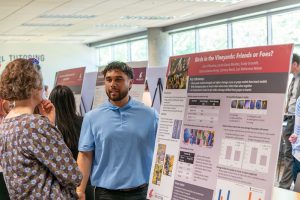
Jairo Villasenor presents his team’s research on what birds are eating in local vineyards to WSU Tri-Cities faculty member Dr. Sarah Roley.
Students Clarissa Garcia Arroyo, Grady Grasseth, Carola Garcia Mendez, Zachary Shortt, Jairo Villasenor, and Lori Wollerman Nelson reported on the results of their study on what birds are eating in local vineyards — and whether these winged neighbors are friends or foes to wine growers?
“It’s a little of both,” Villasenor, an environmental and ecosystem sciences major, concluded.
For his team’s five-week experiment, the group created fake grapes and worms from plasticine clay, which they distributed throughout the WSU Tri-Cities research vineyard. At the end of each week, from October to November, the group collected the scattered items and assessed each item for damage to determine if a bird had tried to eat it before repeating the process.
“We had clusters of grapes alone. We had clusters of grapes and worms together. And we also had worms just by themselves,” Villasenor said. “Birds ultimately preferred grapes by themselves, and they also preferred worms by themselves. They did not prefer when they were together.”
While the birds showed a stronger preference for grapes than worms in general, Villasenor said it might be because the quantity of plasticine grapes was also significantly higher.
Hydrogen Hogwash takes over East Building stairwell
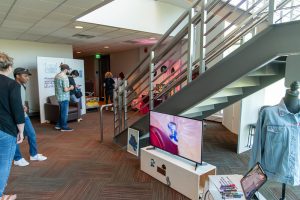
The exhibition “Ctrl + Alt + Create.”, put together by 12 DTC students, included installation, video, and multimedia projects.
Tucked away in a different corner of campus, an artist collective comprising 12 digital technology and culture (DTC) majors transformed a ground-level East Building stairwell area into a warm and vibing 24-hour pop-up exhibition dubbed “Ctrl + Alt + Create.” Each of the 12 artists, who went by the name Hydrogen Hogwash, contributed to the space with an interactive multimedia experience.
Sophia Valdez enticed visitors to sit and relax with a turntable, headphones, and selection of vinyl records. Claire Giles projected an animated vignette she’d pieced together from marked-up video taken during a spring break road trip.
Jo Pickard mounted his artwork to three panels of a makeshift wall set up at the base of the stairwell. His pieces included a framed collage of famous pop-culture heroes and a full-length mirror partially adorned with two emblematic superhero symbols — giving viewers a chance to see and reflect on their own inner hero. He also incorporated a scannable Spotify playlist of heroic tunes to set the mood.
“It’s really easy to be heroic when you’re a superhero,” Pickard said. “But being heroic is whatever you think. It’s like waving at somebody when they’re having a bad day, being nice to someone, helping where you don’t have to.”
The exhibit served as the DTC majors’ capstone project, which also involved the creation of a Hydrogen Hogwash zine featuring humorous and imaginative depictions of animals being transformed by radiation exposure. Copies of the zine were available to view at the exhibit as well.
“I have always been an artist to some degree my entire life, and just getting the chance to work with a team and put this together has been really gratifying,” Pickard said. “I feel like I’ve really come into my own since being here these last couple years.”
Awards and honors
The showcase concluded with a brief presentation of awards, voted on by a handful of faculty and industry guest judges.
Associate professor of mathematics and event organizer Ryan Learn stressed the importance of honoring the impressive scope and caliber of students’ scientific and artistic achievements.
“This is an opportunity to recognize all of the really great work that students are doing beyond the curriculum,” Learn said. “Some of these people are answering questions that have never been answered before, solving problems that have never been solved before.”
Prior to the main showcase poster presentations, event organizers welcomed a group of juniors from Delta High School who participated in some interactive activities. Many of the same student groups from the School of Engineering and Applied Sciences also presented their senior caps during a separate SEAS Design EXPO event on Friday.
The showcase received funding from Battelle Foundation and Washington Research Foundation.
Here are the award winners by category.