



February 12, 2026 WSU Tri-Cities Alumna Leads the Charge in Effective Health Science Communication
By Flynn Espe
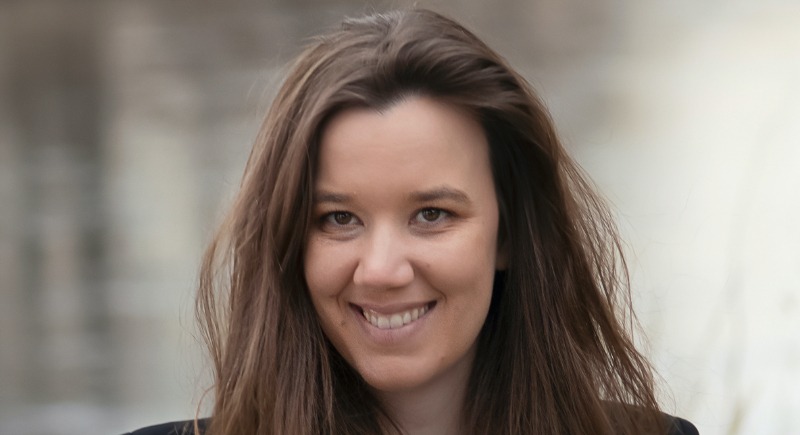
In the world of medicine, Washington State University Tri-Cities alumna Kristen Panthagani (’10 BS Chem.) is a rare breed of doctor. Having earned both an MD and PhD, she belongs to a select group of physician scientists who split their time between clinical work and research.
Now in her fourth year of an emergency medicine residency at Yale New Haven Hospital in Connecticut, she spends part of her schedule in focused scientific study and the rest providing hands-on care to emergency room patients alongside a team of fellow doctors and nurses. Her clinical workload averages about 12 shifts every four weeks, and if you’ve ever watched the HBO Max medical drama The Pitt, she says, it’s kind of like that — though not always as extreme.
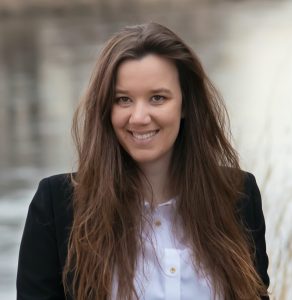
Photo by Megan Beck Photography.
“The shift they show is like the worst shift you can possibly think of in terms of how much craziness comes in,” Panthagani says with a laugh. “But the chaos, clinical cases, and healthcare system overload they show are real. The show does an amazing job capturing the reality of our healthcare system.”
But there’s another angle to Panthagani’s career that sets her apart among her peers and colleagues. In addition to being both a doctor and a researcher, she’s also a professional content creator, with a large following on multiple social media platforms. As the author of the online newsletter You Can Know Things, she writes regularly about a wide range of health science topics.
With article headlines like “How do I find accurate health information online?” and “Why I stopped using the word ‘misinformation,’” much of her writing brings a critical perspective to the overarching question of how to discern fact from speculation. In doing so, she aims to help bridge the gap between health science institutions and the public.
“There unfortunately has not been a lot of investment from the academic world into this more informal style of public communication. But a lot of people get their health information on social media, so there’s this disconnect,” Panthagani says. “One of my goals is to help meet that need and be one of the people who can translate from academia into the social media space in a way that still is accurate.”
Her work has gained national attention. Since launching her website roughly six years ago, Panthagani has been interviewed by The New York Times, appeared on podcasts, written guest pieces for outlets such as Scientific American and The Wall Street Journal, and more. In a recent interview with Nature magazine, Panthagani discussed how poor public communication during the COVID 19 pandemic contributed to declining trust in vaccines.
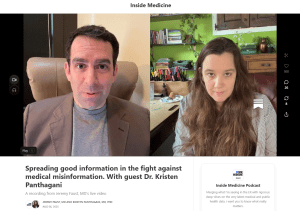
Kristen Panthagani appears on the Inside Medicine podcast to discuss health communication.
“Communications isn’t the standard career path of people who have this degree training,” she says. “But for me, it’s worked out really well.”
It’s also not a path she intended to pursue — at least not at first. As an undergraduate student, Panthagani chose chemistry as her first major.
“I really liked math, but I wanted to be a pre-med,” she says. “So I picked the major that I thought would give me a good balance of the pre-med courses but still some math.”
As for selecting WSU Tri-Cities, Panthagani says she initially based her decision on two practical considerations: affordability and location. Having grown up in West Richland, she says, the chance to be near family was a key factor. The education she received, on the other hand, proved even more valuable in terms of faculty mentorship and hands-on experience.
“The research opportunities really helped solidify what I wanted to do and opened a lot of doors,” Panthagani says.
For two years during her studies — and for an additional year after graduating in 2010 — Panthagani worked as a research assistant at Pacific Northwest National Laboratory, studying the biochemistry of fungi for biofuels applications. Through that work, Panthagani became the first WSU Tri-Cities student to receive the prestigious Barry M. Goldwater Scholarship.
“It was basically doing genetics research on different types of fungi to figure out how to use them to break down leftover plant matter and convert them into useful chemicals,” she says. “It’s given me a strong foundation for the research I’ve done since then.”
When looking into medical schools, it was her faculty mentor, Vice Chancellor for Academic and Student Affairs Kate McAteer, who encouraged her to consider an MD/PhD program.
“It was very evident that Kristen had a passion for science. Even as an undergraduate, she had a gift for asking challenging questions and investigating them with rigor and determination,” McAteer says. “I also knew she had her heart set on medical school, which is why I suggested she look into becoming a physician scientist, because it seemed like that type of dual training might be a great fit for her.”
Panthagani ultimately enrolled at Baylor College of Medicine in Texas, where she completed her doctoral thesis on the human gut microbiome. It was there, almost by accident, that she discovered her talent for public-facing communication.
As Panthagani recalls, it was the second week of March 2020. The World Health Organization had just declared COVID-19 a pandemic. As the earliest U.S. cases of the virus were beginning to emerge, a sense of worry and confusion was slowly building. Panthagani was sitting in her office and looking over data, trying to get a sense of what to expect next.
“There was a crowdsourced Google sheet of COVID cases across different countries, and I was plotting the U.S. versus Italy, which had spiked before us,” Panthagani says. “They were, by that time, in a state where their healthcare system was starting to feel the strain, and we were still kind of early. But I plotted it, and I could see that we were on the same trajectory as Italy.”
Her projections were grim.
“I was like, ‘Oh, well, that looks bad,’” she says. “And I remember feeling very conflicted about whether or not I should post it.”
Shouldn’t someone in government with more clout and expertise be getting the word out through official channels, she wondered? Why should it be left to a graduate student on social media to do the job of health officials?
“I finally decided to post it, and it got a lot of attention,” Panthagani says. “People really appreciated it.”
A few months later, following another viral post, she launched You Can Know Things. Today, the newsletter has thousands of subscribers.
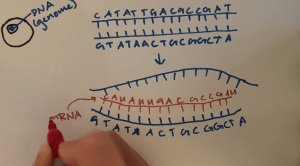
From her YouTube video “How mRNA works (and why mRNA vaccines won’t turn you into a GMO),” Panthagani debunks myths surrounding COVID-19 vaccines.
At first, Panthagani focused on debunking COVID-19 myths and rumors circulating online, addressing topics such as mask effectiveness and treatments like hydroxychloroquine. Her dual-degree background proved especially useful.
“In the communication space, that’s been really valuable because I can speak from both perspectives,” she says. “I work in a hospital and I see patients directly, and I have the scientific training to dig into a study really well.”
In the years since the height of the pandemic, both her writing and research have shifted toward how to effectively communicate health science to the public. For institutions, she says, that requires understanding how the media landscape has changed.
“I’m very much a proponent of physicians and scientists getting on social media, but I think it’s bigger than that,” she says. “People want to feel that you’re giving them your raw, unfiltered thoughts and that you’re being a real person, and that’s the exact opposite of what we’re taught to do in academia.”
For her non-academic readers, Panthagani hopes to provide tools for identifying trustworthy information.
“A lot of the inaccurate information is paired with somebody who’s trying to sell a product,” she says, highlighting one common red flag. “That’s not always true, but it’s often true — especially online.”
With one fellowship year left at Yale, Panthagani is unsure what comes next. For now, she enjoys balancing an independent academic career with the support and camaraderie of the emergency room.
“People who go into emergency medicine tend to be very chill, relaxed people, which maybe seems counterintuitive because we’re dealing with chaos, but they actually go very well together,” she says.
McAteer, meanwhile, says she’s enjoyed following her former student’s career, pointing to Panthagani’s success as an example of how the STEM fields and other academic disciplines can work hand-in-hand.
“One thing we strive to teach our students is to embrace that multidisciplinary mindset, regardless of what their major is,” McAteer says. “I’m so proud of Kristen for going on from WSU Tri-Cities and becoming a trailblazer in this science communications space. She’s still doing what she’s always done — identifying a need and stepping up to the challenge.”