




November 13, 2025 WSU students take part in Global Model WHO conference in Geneva
By Flynn Espe
Three undergraduate Washington State University students traveled to Geneva, Switzerland, last month to take part in the Global Model WHO 2025 conference. For four days at the World Health Organization headquarters, the trio joined more than 400 high school and college student delegates from approximately 40 countries in a series of simulations focused on diplomacy and consensus building.
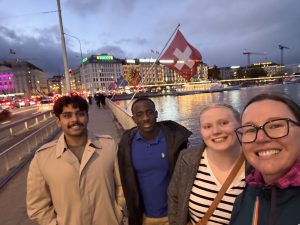
Bhargav Iyer, Romeo Ross, Zoe Pfeifer, and Anna Plemons represented WSU at the Global Model WHO 2025 conference in Geneva, Switzerland.
The WSU students who participated were Bhargav Iyer, a senior biology major from WSU Pullman; Zoe Pfeifer, a senior biology major from WSU Tri-Cities; and Romeo Ross, a sophomore social sciences major from WSU Tri-Cities. Anna Plemons, associate vice chancellor for academic and student affairs for WSU Tri-Cities, also traveled as the group’s faculty advisor. The trip was partially funded thanks to a donor contribution to the WSU Tri-Cities Dynamic Student Engagement Fund, as well as the Phil and June Lighty Student Leadership Development Fund.
Like a Model United Nations summit, in which each student takes on the role of ambassador for a UN nation, the Global Model WHO conference had student delegates serving as mock representatives for a WHO member country. Daily simulation sessions were divided across six committees, each tackling a different global health topic. All three WSU delegates took part in the committee titled “Equity and Integration to Prevent and Control Noncommunicable Diseases (NCDs).”
“Before arriving, we had to write a position paper,” Pfeifer, who represented the Philippines, said. “It required intensive research to figure out your positions, find the rates of diseases, or NCDs, and just familiarize yourself with your country.”
Through several rounds of dialogue and debate, students advocated for draft resolution language changes that would best advance the policy needs of their respective nations. While some portions of the simulations had students negotiating with one another in smaller regional groups, other segments were dedicated to open-forum discussion, in which any delegate was free to raise their country flag to make a statement.
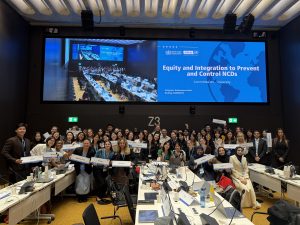
All three WSU student delegates took part in the “Equity and Integration to Prevent and Control Noncommunicable Diseases” committee as they took on the role of mock representatives.
“As soon as you press the mic, there are multiple cameras around the room and it all pans on you,” Ross, who represented the Dominican Republic and also served as a plenary speaker at the conference, said. “I definitely improved in my public speaking and the nerves I had prior to that.”
At the end of the conference, Iyer received a Diplomacy Award for exemplary representation on behalf of his assigned country, Panama.
“I’m incredibly grateful to receive this award and am proud to represent WSU in this international space,” Iyer said. “My biggest takeaway from this trip was reassurance in the fact that we can solve so many pressing issues by coming together and working on them. Intentional collaboration and effective communication are key pillars to passing meaningful policy, and despite the many cultural and linguistic barriers, I was impressed with the work that students did at this conference.”
According to WHO, noncommunicable diseases—such as cancers, diabetes, chronic respiratory diseases and cardiovascular diseases—killed at least 43 million people in 2021. Additionally, roughly 73 percent of NCD deaths occur in low- and middle-income countries.
“For the country I represented, NCDs contributed to 68 percent of the deaths in that country, so it’s a big issue,” Pfeifer said.
To set the stage for the proceedings, the opening sessions took place inside the WHO executive boardroom. That’s where students heard directly from world health leaders and were reminded of the many historic health causes—from decreasing worldwide polio outbreaks to combating COVID-19—that had been championed within that very space.
“When they started, they told us, ‘This is the room where the smallpox problem got solved,’” Pfeifer said. “It was like, ‘Holy cow!’”
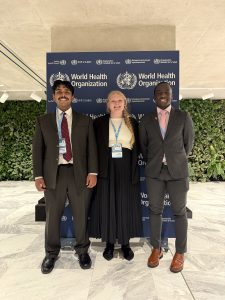
Romeo Ross (right) first brought the opportunity in Geneva to Plemons’ attention due to his strong interest in international law.
“This is a building that I’ve seen on TV,” Ross echoed. “It’s something that I really did appreciate, especially being in that room with so much history and significance. It was a surreal feeling.”
As someone with a strong interest in international law and humanitarian work, Ross said he had long wanted to gain firsthand UN experience, either through a student internship or other opportunity. After hearing about the Global Model WHO conference over the summer, it was he who first brought the opportunity to Plemons’ attention.
Plemons, in turn, instigated the conversations among WSU Tri-Cities staff and faculty that led to the trip being greenlit and funded as an official WSU activity. She also arranged to offer and teach a one-credit UNIV 490 Global Leadership Experience course this semester, with the goal of giving Pfeifer and Ross the space and academic resources to participate in the Geneva event.
“It was very evident to me that there is real value in these kinds of experiences, and I am excited about WSU continuing to get students into the spaces where this kind of deep, contextualized learning and intercultural exchange is happening,” Plemons said, noting that WSU was one of just four American universities—and the only public university—to send students to the conference.
Outside of the simulations, students also got to take part in nightly cultural exchange activities involving food, language and dance. The WSU students said they enjoyed the opportunity to meet and engage with students from around the world, including from countries that have had tense or strained diplomatic relations with the United States.
“Having conversations with individuals from those countries, you get to see they’re some of the nicest people,” Ross said.
“Everyone there was on the same level,” Pfeifer said. “It was so interesting to bridge that gap of everything we’ve been taught in school about certain countries or certain cultures and just see it for yourself.”
In addition to exploring Geneva, the three WSU students also used their free time to visit Annecy, France, and Bern, Switzerland. Global Model WHO is an annual event organized by the World Federation of United Nations Associations. This year’s conference took place Oct. 28–31.
Check out this conference recap from WIMUN Secretariat!